






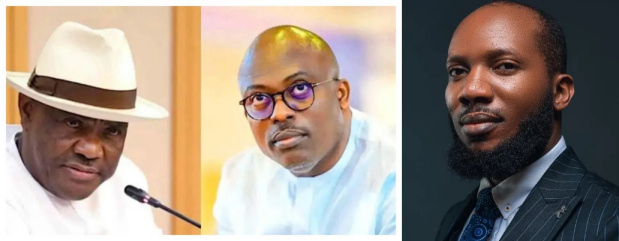
Human rights lawyer, Inibehe Effiong, has stripped the Rivers State political crisis of its legal dressing, describing the face-off between Federal Capital Territory (FCT) Minister, Nyesom Wike, and Governor Siminalayi Fubara as a raw struggle for power and resources.
Speaking on The Morning Brief, a Channels Television programme monitored on Friday, Effiong said the drama unfolding in Rivers State has little to do with constitutional interpretation and everything to do with deep-seated political hostility between the two former allies.
According to him, attempts to frame the crisis as a constitutional dispute amount to “legal sophistry,” designed to distract Nigerians from the real issue at stake which is control of Rivers State’s enormous wealth.
Effiong stressed that Rivers State, as one of Nigeria’s most resource-rich states and a major contributor to the nation’s oil revenue, sits at the heart of fierce political interests. He noted that the struggle is fundamentally about who controls the state’s finances and political machinery.
“The House of Assembly never really cared about the constitution,” the lawyer said, arguing that the lawmakers’ actions are driven by politics rather than concern for governance or the rule of law.
He further referenced allegations attributed to the FCT minister suggesting that as much as ₦600 billion is at stake, with multiple political actors allegedly angling for a share of the funds.
- Tinubu Flags Off $100m Southeast Gas Pipeline Project to Boost Industrial Growth
- NCC Raises Alarm Over AI-Powered Cyberattacks, Warns of Threats to Telecoms, Banks and National Security
- State Police Nears Reality as 30 State Assemblies Approve Constitutional Amendment
- FG Approves N70,000 Monthly Transport Allowance for Workers for Six Months, Begins November
- Fleetwood Town Stun Arsenal in Historic Carabao Cup Upset, Win 5-3 on Penalties
“This is about the money of Rivers State,” Effiong stated bluntly. “It is about private interests that have now been elevated into a full-blown state crisis.”
Questioning the moral basis of the conflict, the lawyer asked whether the lawmakers were fighting over unconstructed roads, failing hospitals, or the welfare of Rivers residents concluding that the people’s needs are clearly not the driving force behind the showdown.
Effiong’s comments add to growing public scrutiny of the Rivers crisis, as many Nigerians increasingly view the dispute as a power tussle masked by legal arguments, rather than a genuine fight for democracy or good governance.