






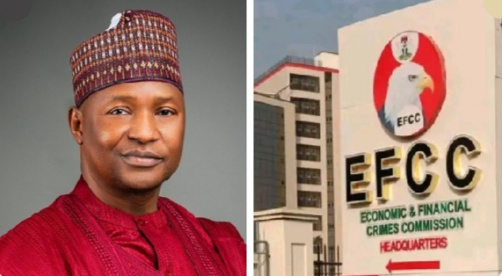
Nigeria’s anti-corruption agency, the Economic and Financial Crimes Commission (EFCC), has intensified legal efforts to permanently confiscate 57 high-value properties allegedly linked to former Attorney-General of the Federation, Abubakar Malami, in a case that underscores growing scrutiny of public office holders’ wealth.
The EFCC, in a motion filed before the Federal High Court in Abuja, is asking the court to grant a final forfeiture order transferring ownership of the assets to the Federal Government. The application follows an earlier interim forfeiture granted in January 2026.
Arguing the case, the commission’s legal team, led by Senior Advocates Jibrin Okutepa and Ekele Iheanacho, told the court that the respondents failed to provide sufficient evidence to overturn the interim order. The EFCC maintains that the properties are “reasonably suspected to be proceeds of unlawful activities,” invoking provisions of the Advance Fee Fraud and Other Fraud-Related Offences Act, 2006.
The suit, marked FHC/ABJ/CS/20/2026, lists Malami, members of his family, and several companies allegedly linked to him as respondents. The case is being heard by Justice Joyce Abdulmalik, who has scheduled further proceedings for April 21, 2026.
According to an affidavit deposed by EFCC investigator Daniel Adebayo, the probe was triggered by multiple petitions alleging corruption, abuse of office, and fraud. Investigations reportedly involved financial record tracing through banks and the Central Bank of Nigeria, as well as collaboration with agencies including the Corporate Affairs Commission, Federal Inland Revenue Service, and the Code of Conduct Bureau.
The commission also extended its inquiry to land registries across several states and conducted physical verification and valuation of the properties. The assets, spread across Abuja, Kebbi, Kano, and Kaduna, are collectively estimated at about N213.2 billion.
- Tinubu Flags Off $100m Southeast Gas Pipeline Project to Boost Industrial Growth
 President Bola Tinubu has flagged off a $100 million gas…
Read More “Tinubu Flags Off $100m Southeast Gas Pipeline Project to Boost Industrial Growth” »
- NCC Raises Alarm Over AI-Powered Cyberattacks, Warns of Threats to Telecoms, Banks and National Security
 The Nigerian Communications Commission (NCC) has warned that the growing…
Central to the EFCC’s case is the claim that the value of the properties is grossly disproportionate to Malami’s known legitimate earnings while in office between 2015 and 2023. Investigators stated that his total salary over the period stood at approximately N89.6 million, alongside allowances and estacodes, figures they argue do not align with the scale of the assets under scrutiny.
The affidavit further alleges that several of the properties were acquired through proxies and corporate entities, while some developments lacked proper building approvals, suggesting attempts to conceal the origin of funds.
This latest move builds on an earlier ex parte order granted by Justice Emeka Nwite, which temporarily forfeited the properties and directed the EFCC to publish notices inviting interested parties to show cause why the assets should not be permanently seized.
Malami and other respondents had challenged the interim forfeiture, urging the court to set it aside. However, the EFCC insists that no compelling justification has been presented to halt the final forfeiture process.
The outcome of the case is expected to be a significant test of Nigeria’s non-conviction-based asset forfeiture regime, particularly in high-profile cases involving former senior government officials.


