






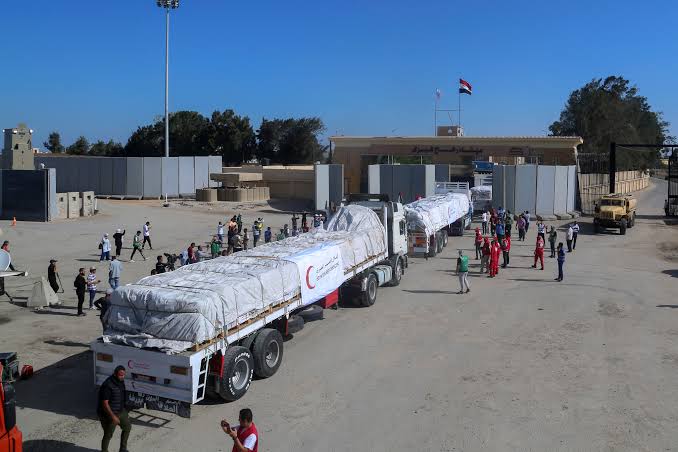
The United Nations said a 20-truck convoy carried “life-saving supplies,” which the World Health Organization warned would “barely begin to address the escalating health needs” in Gaza.
The convoy of 20 trucks, carrying aid moved through the Rafah border crossing into Gaza from Egypt on Saturday, according to the United Nations, after days of diplomatic wrangling to get food, water and medicine into the blockaded enclave where supplies were running out and hospitals were nearing collapse.
Aid officials welcomed the breakthrough but warned that the trucks, which the United Nations said carried “life-saving supplies,” were barely enough to start addressing the spiraling humanitarian crisis in Gaza.
There were 44,000 bottles of drinking water supplied by UNICEF in the aid convoy that crossed into Gaza today, the United Nations Children’s Fund said in a statement. This is “just enough” for 22,000 people for a day, it added. Water production capacity in the Gaza Strip is at five percent of normal levels, according to UNICEF, and about 2.3 million residents are surviving on three liters of water per person per day.
- Europe Erupts Over Rising Fuel Prices as Cities Battles Soaring Cost of Living and Economic Hardship
 Rising fuel prices, soaring household expenses and dissatisfaction with public…
- Niger Republic Bans Petrol, Diesel Exports as Fuel Shortages Deepen, Prioritises Local Consumers
 The Republic of Niger has prohibited the export of premium…
“The people of Gaza need a commitment for much, much more — a continuous delivery of aid to Gaza at the scale that is needed,” the U.N. secretary general, António Guterres, said in a speech in Cairo.
Humanitarian aid workers had expressed hopes that fuel, which Gaza’s struggling hospitals need to generate power, be allowed into the enclave — a prospect the Israeli military spokesman, Daniel Hagari, appeared to rule out on Saturday, at least for the time being.
Several U.N. and European officials and diplomats familiar with talks around opening the crossing said that the primary concern voiced by Israel’s government was that the aid not strengthen or fall into the hands of Hamas, which killed more than 1,400 people and captured about 200 hostages in its Oct. 7 assault into Israel.
Fuel is particularly contentious, as Israel worries it could get diverted to Hamas to be used for weapons or its vehicles.
Meanwhile as the situation in Gaza worsens, Israel is readying a ground offensive in the territory. The timing of any invasion is unknown, but Israel is gathering forces near the border. Military analysts said that an extended campaign could result in heavy casualties on both sides.
The Egyptian government is hosting a summit in Cairo aimed at de-escalating the war. In attendance are representatives of the Arab world and Western countries, including many that Arab nations have criticized for being quicker and more enthusiastic in their support of Israel than in their calls to protect civilians in Gaza.
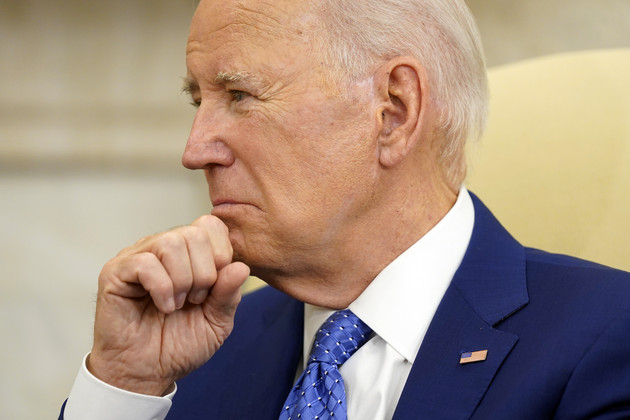
Mr. Biden and his top aides are trying to head off any major Israeli offensive on Hezbollah, the powerful militia in Lebanon, believing that Israel would struggle with a two-front war and that such a conflict could draw in both the United States and Iran, U.S. and Israeli officials say.
Reports have it that death toll from the bombing on Tuesday of a school-turned-shelter in the Maghazi refugee camp in central Gaza rose to eight, according to UNWRA, the agency that administers aid to Palestinians. About 40 others were wounded in the attack, including three UNRWA employees.