


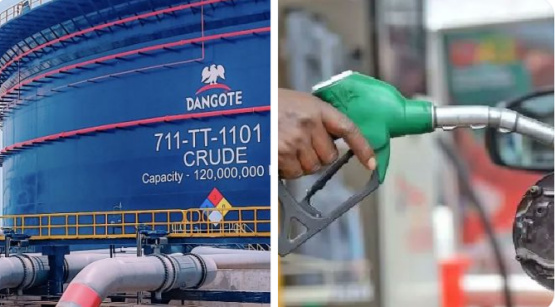
Nigeria’s fuel market has recorded another upward shift as the Dangote Refinery increased the ex-depot price of Premium Motor Spirit (PMS), commonly known as petrol, from ₦1,245 per litre to ₦1,275 per litre.
The latest adjustment marks yet another price review in March 2026, reflecting continued volatility in Nigeria’s downstream petroleum sector. Reports indicate that this is among multiple price changes implemented by the refinery within the month, underscoring rapid fluctuations in supply and cost dynamics.
Earlier in the same period, the refinery had already raised petrol prices to ₦1,245 per litre from ₦1,175, continuing a pattern of incremental increases. Prior to that, prices had oscillated significantly—dropping briefly to around ₦1,075 per litre before rebounding due to market pressures.
Industry sources attribute the repeated price hikes primarily to rising global crude oil prices, which directly impact refining costs. A recent surge in crude benchmarks to around $100 per barrel has significantly increased the cost of production, forcing refiners to adjust prices upward.
Geopolitical tensions in key oil-producing regions have also contributed to supply concerns, further pushing up global oil prices and, by extension, domestic fuel costs.
The frequent adjustments have created uncertainty across Nigeria’s fuel distribution chain, with depot operators and marketers often pausing transactions to reassess pricing structures after each review.
- AFCOM-HS: New Military Medical College Listed on JAMB Portal for 2026/2027 Admission
 The Armed Forces College of Medicine and Health Sciences (AFCOM-HS),…
Read More “AFCOM-HS: New Military Medical College Listed on JAMB Portal for 2026/2027 Admission” »
- Arsenal Sink Everton as Aston Villa Shock Man City in Dramatic Premier League Saturday
 Arsenal strengthened their challenge for the English Premier League title…
Read More “Arsenal Sink Everton as Aston Villa Shock Man City in Dramatic Premier League Saturday” »
For consumers, the increase is expected to translate into higher pump prices nationwide, adding pressure to transportation costs and the broader cost of living.
The Dangote Refinery, a multi-billion-dollar facility located in Lagos, was widely expected to stabilize Nigeria’s fuel supply and reduce dependence on imports. However, recent pricing trends highlight the continued influence of global oil market forces on domestic fuel pricing, even with local refining capacity in place.
As price adjustments continue, stakeholders are closely monitoring how the interplay between global crude prices, exchange rates, and domestic supply conditions will shape fuel costs in the coming weeks.