




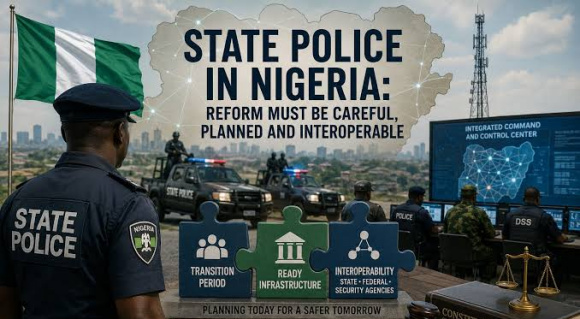
Nigeria’s proposed state police system has moved closer to implementation after 30 of the country’s 36 State Houses of Assembly approved a constitutional amendment paving the way for the establishment of state-controlled police services. The development represents a major step in the ongoing effort to decentralise policing and strengthen responses to security challenges across the country.
The number of approving assemblies has exceeded the constitutional requirement of at least 24 states, representing two-thirds of the 36 states, for a constitutional alteration to secure the necessary state-level concurrence. However, the approval process must still be completed and the remaining constitutional and legislative steps fulfilled before the proposed system can become operational.
Four state assemblies—Lagos, Niger, Kogi and Ebonyi—were among those reported to have endorsed the amendment in the latest round of approvals. Their decisions brought the total number of approving states to 30, reflecting growing legislative support for the proposed restructuring of Nigeria’s policing framework.
In Lagos, lawmakers reconvened from their recess to consider the amendment and unanimously voted in favour. Speaker of the House, Mudashiru Obasa, welcomed the development but expressed concern that the proposed framework did not grant states sufficient autonomy over their police services. He called for a clearer division of responsibilities between federal and state police authorities.
Ebonyi lawmakers also unanimously approved the amendment, with all 24 members of the State House of Assembly voting in support. Speaker Moses Ije Odunwa said the decision reflected the legislature’s commitment to constitutional reforms intended to improve public safety and strengthen the country’s security architecture.
The Kogi State House of Assembly similarly endorsed the proposal unanimously. Speaker Aliyu Umar Yusuf urged lawmakers to support the amendment amid persistent security challenges, including kidnapping, banditry, terrorism, farmer-herder conflicts and other criminal activities. In Niger State, Governor Mohammed Umaru Bago announced that the state assembly had passed the amendment.
The Presidency has also begun engaging the private sector on the financing and implementation of the proposed policing arrangement. Chief of Staff to the President, Femi Gbajabiamila, who chairs the Presidential Working Group on the National Policing Bill, urged organised private-sector groups to develop practical proposals for funding and implementing state police. He argued that insecurity disrupts businesses, discourages investment, interrupts supply chains and limits employment opportunities.
Gbajabiamila stressed that states must demonstrate the financial capacity to maintain their police services beyond the initial purchase of vehicles, uniforms and other equipment. He identified recurring expenditure, including salaries, professional training and operational maintenance, as essential considerations. He also warned that private-sector contributions must be transparent and must not confer influence over police investigations or law-enforcement decisions.
As part of the preparation for the proposed reform, the Presidential Working Group submitted a draft National Policing Bill and 29 consequential amendment bills to the Federal Ministry of Justice on October 19 for review. According to the Presidency, the proposals are expected to undergo further consideration before being presented to President Bola Tinubu for approval and subsequent transmission to the National Assembly.
Senate President Godswill Akpabio has defended the proposed state police system, maintaining that it would complement rather than replace the existing federal police structure. However, criminologist Professor Etannibi Alemika has cautioned that decentralising policing without effective safeguards could expose state police institutions to political interference. He has also argued that insecurity requires broader responses to underlying problems such as poverty, unemployment, inadequate education and poor governance.
Although the approval by 30 state assemblies marks significant progress, questions remain about funding, operational independence, oversight and the prevention of political abuse. The proposed framework is expected to provide safeguards, professional standards and mechanisms for accountability. The final legislative and constitutional steps will determine how the system is established and the extent of authority state governments will exercise over their police services.
- Tinubu Flags Off $100m Southeast Gas Pipeline Project to Boost Industrial Growth
 President Bola Tinubu has flagged off a $100 million gas…
Read More “Tinubu Flags Off $100m Southeast Gas Pipeline Project to Boost Industrial Growth” »
- NCC Raises Alarm Over AI-Powered Cyberattacks, Warns of Threats to Telecoms, Banks and National Security
 The Nigerian Communications Commission (NCC) has warned that the growing…