


The Federal Government has selected five states and the Federal Capital Territory for the pilot implementation of Nigeria’s National Ranching Policy, in a major step towards reforming livestock production and addressing persistent farmer-herder conflicts across the country.
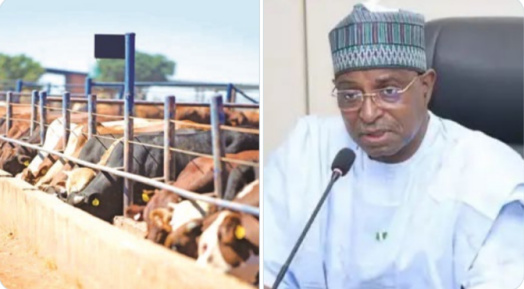
The Minister of Livestock Development, Idi Mukhtar Maiha, disclosed the development on Tuesday after briefing President Bola Ahmed Tinubu on the activities of his ministry at the Presidential Villa in Abuja.
The states selected for the pilot programme are Benue, Plateau, Nasarawa, Kaduna and Adamawa, alongside the Federal Capital Territory. According to the minister, the locations were chosen partly because they have experienced some of the highest levels of farmer-herder clashes in recent years.
Maiha said the pilot scheme would commence at the Wase Grazing Reserve in Plateau State, which is expected to serve as a proof of concept for the Federal Government’s new approach to livestock management. The initiative is designed to demonstrate how cattle production can be organised within designated ranching communities.
The minister explained that the traditional practice of moving large numbers of cattle over long distances has become increasingly difficult because grazing routes have been affected by agricultural expansion, urbanisation and infrastructure development. He argued that nomadic livestock production is no longer sustainable under present conditions.
Under the proposed ranching model, pastoralists would rear their animals within designated locations, with pasture cultivated close to where the livestock are kept. The government also intends to promote improved grass varieties capable of providing livestock with adequate nutritional value.
Beyond pasture and livestock management, the ranching communities are expected to receive supporting infrastructure, including housing, veterinary clinics, schools, primary healthcare facilities, water supply and solar-powered lighting. The government believes these facilities will make the settlements more sustainable and economically productive.
Maiha said the ranching reserves could eventually develop into livestock-based economic hubs, attracting milk-processing companies, modular abattoirs, bio-digesters and other businesses connected to the livestock value chain. He noted that concentrating cattle production in organised locations could create opportunities for investment and employment.
The Federal Government is also introducing a nationwide livestock identification system using radio-frequency technology. According to the minister, livestock will be tagged to establish identification, geolocation and ownership records, a measure expected to assist efforts against cattle rustling and improve the country’s livestock database.
The ranching policy is being implemented alongside other livestock-development initiatives, including dairy development, fodder cultivation, modern abattoirs and improved veterinary services. The ministry has also been engaging pastoralist organisations, with Maiha saying more than 34 such groups had been consulted as part of efforts to build support for the policy.
The Federal Government’s latest announcement marks a significant expansion of its ranching strategy, although the programme will face the challenge of translating policy into functional and accepted ranching communities. With farmer-herder tensions remaining a major security and agricultural concern, the success of the pilot programme could influence the future direction of livestock production and conflict-management efforts across Nigeria.
- Tinubu Flags Off $100m Southeast Gas Pipeline Project to Boost Industrial Growth
 President Bola Tinubu has flagged off a $100 million gas…
Read More “Tinubu Flags Off $100m Southeast Gas Pipeline Project to Boost Industrial Growth” »
- NCC Raises Alarm Over AI-Powered Cyberattacks, Warns of Threats to Telecoms, Banks and National Security
 The Nigerian Communications Commission (NCC) has warned that the growing…