


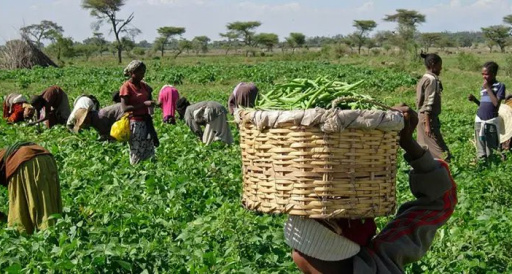
Stakeholders in Nigeria’s agricultural sector have accused some commercial banks of diverting funds meant for farmers into more profitable ventures such as real estate, worsening the country’s food security challenges and limiting access to credit for genuine farmers.
The allegation was made during the 2026 Agriculture and Agro-Allied Summit organised by the Nigerian-British Chamber of Commerce in Lagos, where experts, farmers and financial sector representatives discussed strategies for improving food production and strengthening agricultural investment in Nigeria.
Speaking at a panel session themed “Ensuring Food Security in Nigeria: Innovations, Investments and Policy for a Resilient Future,” agribusiness stakeholder Oyekoya alleged that many financial institutions entrusted with agricultural intervention funds fail to channel the money to real farmers.
According to him, government agencies already possess sufficient data through cooperatives and registered farmer clusters to identify genuine farmers eligible for support, but implementation gaps and weak financial commitment continue to undermine the sector.
Oyekoya claimed that some banks divert agric financing into real estate investments instead of disbursing the loans to farmers as intended. He maintained that the practice has contributed significantly to the persistent funding challenges facing smallholder farmers across the country.
However, representatives of the banking sector pushed back against the accusation. Manager of Agribusiness and Non-Oil Export at Union Bank of Nigeria, Mr. Utomi Ezinwa, argued that agricultural lending remains difficult largely because of the high risks associated with fragmented farming systems and uncertain markets.
Ezinwa explained that lenders are more willing to finance farmers who operate within cooperatives or structured clusters with guaranteed off-take arrangements, noting that repayment risks remain a major concern for banks.
- Tottenham Stun Chelsea at Stamford Bridge as Palmer Sees Red and Maddison Suffers Fresh Injury Blow
 Tottenham Hotspur delivered a statement victory over London rivals Chelsea…
- AFCOM-HS: New Military Medical College Listed on JAMB Portal for 2026/2027 Admission
 The Armed Forces College of Medicine and Health Sciences (AFCOM-HS),…
Read More “AFCOM-HS: New Military Medical College Listed on JAMB Portal for 2026/2027 Admission” »
The latest accusation adds to growing concerns over access to agricultural financing in Nigeria. Recently, the President of the All Farmers Association of Nigeria, Mohammed Magaji, also lamented that many commercial banks remain unwilling to lend to farmers despite the existence of the Agricultural Credit Guarantee Scheme Fund.
Magaji said stringent collateral requirements and harsh lending conditions have made it nearly impossible for small-scale farmers to obtain loans, even as agriculture continues to employ a significant portion of Nigeria’s workforce.
Concerns over the management of agricultural intervention funds have also attracted legislative attention. In late 2025, the House of Representatives Committee on Nutrition and Food Security launched a probe into the alleged diversion and mismanagement of billions of naira allocated to agricultural programmes, including intervention schemes linked to the Central Bank of Nigeria.
Despite multiple intervention programmes introduced over the years, analysts say inadequate funding access, poor implementation, loan default concerns and weak monitoring mechanisms continue to slow agricultural productivity and threaten Nigeria’s food security ambitions.