






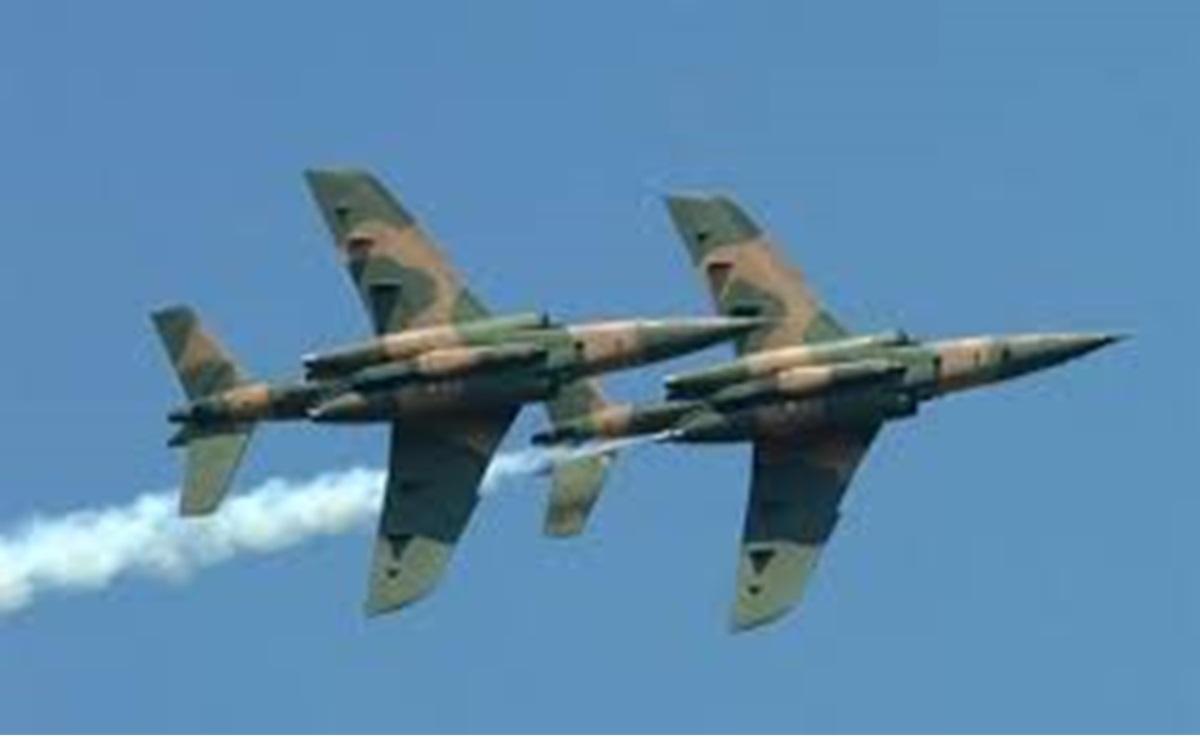
The Nigerian Army has reported that seven precision air strikes across Borno and Adamawa states killed 103 Islamic State West Africa Province (ISWAP) fighters and destroyed several logistics hubs and storage facilities used by the insurgents.
The operations, conducted between October 10 and 18, 2026, were carried out by the Joint Task Force (North-East) under Operation Hadin Kai, as part of efforts to weaken terrorist networks, disrupt their supply chains and restrict their movements across the region.
Captain Mohammed Goni, Acting Military Information Officer at the Joint Task Force headquarters, disclosed the results in a statement issued in Maiduguri. He said the strikes involved coordinated deployments of Nigerian Army Aviation, the Nigerian Army Remotely Piloted Aircraft System (NARPAS) Regiment and Air Component assets.
According to the military, the air campaign targeted insurgent positions around Gudumbali in Guzamala Local Government Area, Badu and Mairari in Monguno and Guzamala local government areas, as well as Duste Uku in Gombi Local Government Area of Adamawa State. The operations were designed to strike fighter concentrations, leadership-linked facilities and locations believed to support the group’s activities.
A major operation was reportedly carried out on October 18 against an alternative residence of Abu Saleem, whom the military identified as the ISWAP Wali of South Lake Chad. The facility, located in the Arina Woje area of Monguno Local Government Area, Borno State, was targeted following intelligence gathering, surveillance and reconnaissance activities.
Goni said subsequent human intelligence confirmed the deaths of two prominent ISWAP figures, Jindullah and Abul Kissa, alongside other fighters at the targeted location. Jindullah was identified as a senior fighter who reportedly served as Abu Saleem’s chief security guard, while Abul Kissa was described as a member of the group’s Shura Council.
The military said the October 18 strike destroyed the targeted structure and damaged or destroyed key logistics assets, including nine boat engines and several motorcycles reportedly kept at the site. It added that the operation disrupted the insurgents’ concealment arrangements in the surrounding forest, reducing the location’s usefulness as a potential hideout and support base.
Another significant strike took place on October 13 after a Guardian air asset reportedly tracked 16 fighters from the Mairari axis to a gathering of more than 100 insurgents accompanied by several motorcycles. The gathering was said to be approximately 23 kilometres east of Badu and 19 kilometres west of Monguno. According to Goni, a subsequent precision strike killed an estimated 30 fighters, although the extent of damage to the motorcycles could not be confirmed.
The other operations targeted insurgent positions and facilities around Gudumbali, Badu, Mairari and Duste Uku. Taken together, the seven strikes reportedly accounted for 103 fighter deaths and the destruction of several logistics hubs and storage facilities. The military said the results would weaken ISWAP’s ability to move supplies, maintain operational bases and sustain attacks across its area of activity.
Operation Hadin Kai said it would continue working with aviation units, remotely piloted aircraft operators and ground forces to maintain pressure on insurgent networks and deny them safe havens in the North-East. While the military’s reported gains point to sustained efforts against ISWAP’s fighting strength and logistics infrastructure, the casualty figures and operational assessments remain claims issued by the military and have not been independently verified.
- Tinubu Flags Off $100m Southeast Gas Pipeline Project to Boost Industrial Growth
 President Bola Tinubu has flagged off a $100 million gas…
Read More “Tinubu Flags Off $100m Southeast Gas Pipeline Project to Boost Industrial Growth” »
- NCC Raises Alarm Over AI-Powered Cyberattacks, Warns of Threats to Telecoms, Banks and National Security
 The Nigerian Communications Commission (NCC) has warned that the growing…