



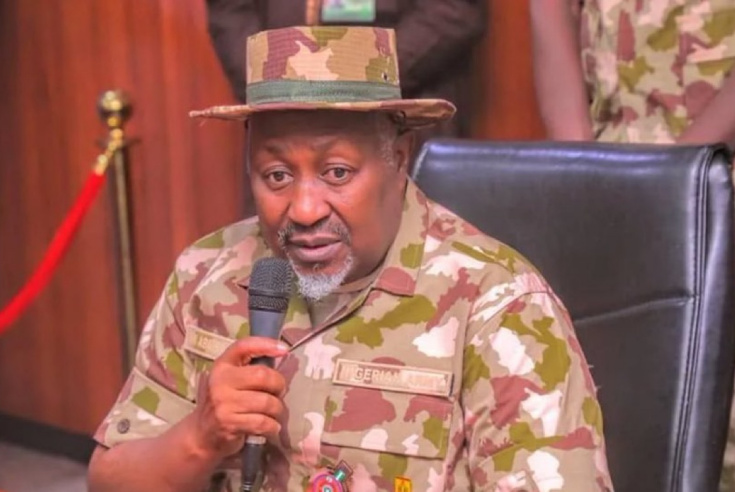
Nigeria’s Defence Minister, Mohammed Badaru Abubakar, has formally tendered his resignation to President Bola Tinubu citing health concerns as the reason for stepping down.
The letter of resignation, dated December 1, was delivered to the President. In response, Tinubu accepted the resignation with immediate effect and expressed gratitude for Badaru’s service to the nation.

💰💰Donations can be made into 👇
ToyinOlomo Int’l Foundation FCMB 7616705014
Thank you.
please note that this is a broacast message
Badaru, who is 63 years old according to the official release, served as Defence Minister from August 21, 2023 when he was appointed by President Tinubu up until his resignation on December 1, 2025.
Prior to his appointment as Defence Minister, Badaru served two terms as Governor of Jigawa State from 2015 to 2023.
- Bournemouth Humiliate Manchester United 3-0 at Old Trafford as Carrick Faces Mounting Pressure
 Bournemouth delivered another painful blow to Manchester United on Sunday,…
- Tragedy in Kogi: Police Corporal Allegedly Kills Female Colleague, Takes Own Life After Reported Relationship Crisis
 A tragic shooting incident involving two serving police officers has…
According to the statement released by the Presidency’s Special Adviser on Information and Strategy, Bayo Onanuga, President Tinubu will likely inform the Senate of his preferred successor later this week, as required by constitutional procedures.
The resignation comes at a sensitive time in Nigeria, following a recent declaration by the government of a national security emergency. The decision to step down amid such heightened security challenges adds extra weight to the leadership transition at the Ministry of Defence.
Speculation has already begun about potential replacements. A prominent name mentioned in media reports is retired Christopher Musa, the former Chief of Defence Staff (CDS), who reportedly met with President Tinubu earlier on Monday. This meeting has fueled widespread expectations that Musa could be nominated as the next Defence Minister.
Analysts suggest that bringing in a former CDS would signal a shift, possibly toward stronger military-led coordination and renewed strategic direction especially as Nigeria wrestles with insurgency, banditry, and rising insecurity across several regions.
President Tinubu acknowledged Badaru’s contributions in his tenure, thanking him for his service and wishing him well. Meanwhile, the administration appears to be moving swiftly to fill the critical defence leadership vacuum.
As Nigerians await an official announcement from the Senate, the sudden exit of Badaru Abubakar raises many questions about continuity in security policy, the direction of the national emergency strategy, and how quickly a new minister can step in to stabilize the Defence Ministry during one of the country’s most challenging security periods.