




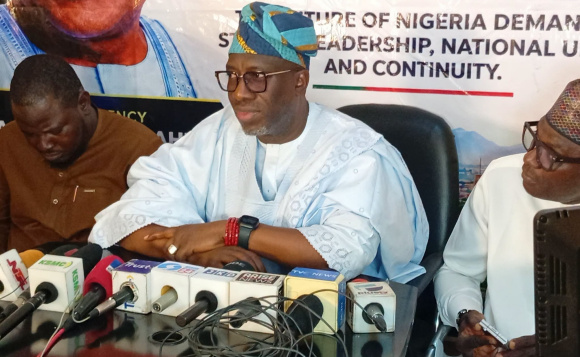
Convener of The Alternative Movement, Otunba Segun Showunmi, has called on the National Security Adviser (NSA), Mallam Nuhu Ribadu, to establish clear and enforceable boundaries for political conduct, warning that inflammatory statements, intimidation and irresponsible political activities could further undermine Nigeria’s national security.
Showunmi made the call in an open letter addressed to Ribadu on Monday, November 16, 2026, titled “On the Urgent Need to Establish Firm Boundaries for Political Conduct and Hold Those Who Threaten National Security Accountable.” He expressed concern that Nigeria was navigating a delicate security environment that required vigilance, institutional coordination and responsible leadership, rather than additional threats arising from political competition.
The political figure warned that personal ambitions, partisan disagreements and the growing toxicity of political communication must not be allowed to compound the country’s existing security challenges. He argued that there was an urgent need to distinguish legitimate political engagement from statements and actions capable of provoking violence, threatening public peace or creating communal tensions.
“There is a difference between robust political engagement and conduct that deliberately or recklessly threatens public peace. There is a difference between criticising the government and deliberately inciting citizens against one another,” Showunmi stated, expressing concern over the increasing normalisation of provocative statements, ethnic and religious insinuations, threats and the manipulation of sensitive national issues for political advantage.
He further observed that some politicians, party loyalists, public commentators and influential supporters appeared to operate under the assumption that their political connections or positions of influence could shield them from the consequences of irresponsible conduct. According to him, such an attitude must be challenged because political relevance should never confer immunity from accountability. He maintained that participation in democratic politics does not give anyone the licence to endanger the country.
To address the situation, Showunmi proposed six measures for urgent consideration by the Office of the National Security Adviser. These include establishing and publicly communicating clear national standards for political communication, ensuring impartial application of the law, creating a coordinated rapid-response mechanism against political misinformation and incitement, and holding political parties and their leadership structures accountable for the conduct of individuals operating under their banners.
Other recommendations include establishing clear protocols for early intervention against credible security threats and ensuring that accountability is not influenced by political hierarchy, personal relationships, financial influence or proximity to those in government. He stressed that serving and former public office holders, party leaders, political financiers, campaign spokespersons and ordinary supporters should all be subject to the same legal standards where evidence of criminal wrongdoing exists.
The Alternative Movement convener, however, clarified that his intervention was not intended to encourage the suppression of opposition voices, silence legitimate criticism or criminalise political disagreements. He acknowledged that dissent, peaceful protests, criticism of government policies and competing political visions were indispensable elements of democratic governance. Nevertheless, he insisted that democratic freedoms must not become instruments for threatening the country’s peace, stability and continued existence.
Showunmi also emphasised that any government response to dangerous political conduct must be guided by established legal standards, credible evidence, due process and respect for fundamental rights. He cautioned against blurring the distinction between legitimate political expression and criminal conduct, insisting that security institutions must act responsibly while ensuring that individuals who cross the legal threshold are held accountable.
The open letter was also copied to President Bola Ahmed Tinubu, Minister of Defence, General Christopher Musa (retd.); Special Adviser to the President on Homeland Security, Major General Adeyinka A. Famadewa (retd.); Inspector-General of Police, Olatunji Disu; Director-General of the Department of State Services, Oluwatosin Ajayi; and Minister of State for Defence, Bello Muhammad Matawalle. His appeal comes amid heightened political activities ahead of the 2027 general elections and follows President Tinubu’s November 13 warning against political violence, in which he directed security agencies to act firmly against thuggery and other anti-democratic activities.
Concluding his appeal, Showunmi urged Ribadu to send an unequivocal message that no political office, influence or ambition would place anyone above the law. He warned that Nigeria must not wait for an avoidable national tragedy before demonstrating institutional resolve, declaring that national security was a collective responsibility and that no individual’s political ambition was worth sacrificing the country’s peace, stability and security.
- NANS Decries NDLEA Proposed N10,000 Drug Test Fee, Says Students Are Not Revenue Sources
 The National Association of Nigerian Students (NANS) has criticised the…
- Zubimendi Open to Chelsea Switch as Arsenal Demand €70m for Midfield Star
 Arsenal midfielder Martin Zubimendi is reportedly open to a possible…
Read More “Zubimendi Open to Chelsea Switch as Arsenal Demand €70m for Midfield Star” »