



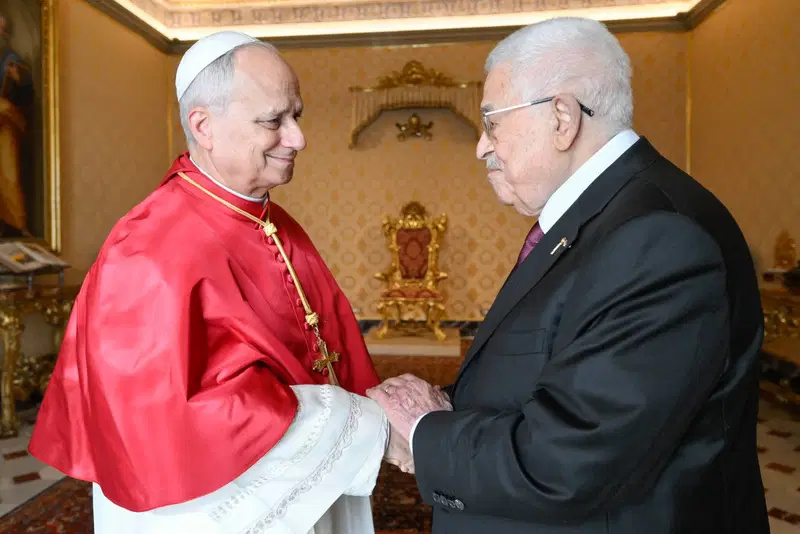
Pope Leo XIV on Thursday received Palestinian President Mahmoud Abbas at the Vatican, marking a renewed push by the Holy See for peace and humanitarian relief in the Middle East. The private audience, held inside the Apostolic Palace, came amid escalating concerns over the worsening humanitarian situation in Gaza and the faltering two-state peace process.
The Vatican described the meeting as “cordial,” noting that it focused heavily on restoring dialogue between Israelis and Palestinians and ensuring the immediate delivery of aid to civilians affected by the ongoing conflict. The encounter also coincides with the 10th anniversary of the 2015 Comprehensive Agreement between the Holy See and the State of Palestine, which formalised full diplomatic relations and Vatican recognition of Palestinian statehood.
President Abbas’s visit began with a symbolic gesture at the Basilica of St Mary Major in Rome, where he laid flowers at the tomb of the late Pope Francis and offered prayers for peace. The visit underscored the long-standing relationship between the Vatican and the Palestinian leadership, which dates back decades and is built on shared concerns for justice, human dignity, and inter-religious coexistence.
During their discussions, Pope Leo XIV reiterated the Holy See’s consistent position that only a genuine two-state solution can deliver lasting peace in the region. He emphasized that both sides must return to negotiations grounded in mutual respect and humanitarian principles, urging world leaders to prioritize diplomacy over division. According to a Vatican statement, the Pope stressed the “urgent need to provide assistance to the civilian population in Gaza and to end the conflict by pursuing a two-state solution.”
- EFCC Raids Four Illegal Lithium Plants in Ogun, Arrests 14 Chinese Nationals and Nigerian
 The Economic and Financial Crimes Commission (EFCC) has arrested 15…
- 2027 Elections: OK Movement Faults NDC’s Late Campaign Preparations, Questions Grassroots Strength
 The Obi-Kwankwaso (OK) Movement has criticised the Nigeria Democratic Congress…
President Abbas, in turn, thanked the pontiff for the Vatican’s continued moral and diplomatic support, highlighting the role of faith institutions in promoting reconciliation. Sources close to the Palestinian delegation said Abbas called the Pope’s engagement “a light of compassion and justice” amid what he described as “unrelenting suffering” in Gaza. The two leaders also exchanged symbolic gifts, further strengthening ties between the Vatican and the Palestinian Authority.
The meeting comes at a delicate time in Middle East diplomacy, with fragile ceasefires and stalled negotiations between Israel and Palestinian factions. The Vatican’s voice, though spiritual in nature, continues to wield significant moral influence in global affairs—offering an alternative path to reconciliation that blends diplomacy with compassion. Observers note that the Pope’s intervention, though largely symbolic, carries moral weight that few world leaders can match.
In the months leading up to the visit, Pope Leo XIV had repeatedly condemned forced displacement and civilian casualties in Gaza. His consistent appeals for peace and dialogue have resonated across faith boundaries, reflecting the Vatican’s evolving role as a humanitarian advocate rather than a political broker. Thursday’s meeting further reinforced that message, reminding the international community that moral authority can still shape global conscience.
Analysts also view the encounter as a calculated diplomatic move by the Vatican to reaffirm its global relevance in an era of growing polarization. The Holy See’s balanced approach—calling for Palestinian rights while defending the security of Israel—has positioned it as one of the few remaining neutral voices capable of facilitating trust. The Pope’s focus on aid delivery, rather than political posturing, adds urgency to the humanitarian dimension of the conflict.
For President Abbas, the Vatican meeting represents both a symbolic and strategic victory. It offers international visibility at a time when the Palestinian leadership is under pressure to address internal divisions and gain broader recognition for statehood efforts. The optics of a warm welcome at the Vatican, coupled with papal endorsement of peace talks, strengthen Abbas’s diplomatic standing on the world stage.
As the meeting concluded, both sides reaffirmed their shared commitment to dialogue, peace, and the protection of all civilians in the Holy Land. While the road to a lasting resolution remains uncertain, Thursday’s audience served as a poignant reminder that even in times of conflict, bridges of faith and diplomacy can still be built—and that moral conviction remains a vital currency in the pursuit of global peace.