





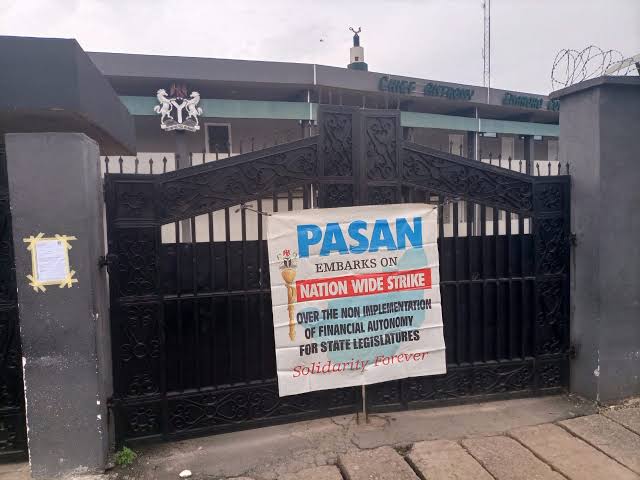
Following several years of agitations, the Parliamentary Staff Association of Nigeria, PASAN, have begun an indefinite strike for the implementation of financial autonomy in legislative houses across the country.
PASAN members in six states who comprise staff in Oyo, Edo, Kano, Ondo and Ogun states, commenced their indefinite strike yesterday and, consequently, shut gates leading into the Houses of assembly.
Their latest action followed the expiration of the ultimatum given to the Federal Government.
The assembly workers in Oyo State, who displayed placards with various inscriptions, to drive home their demands, blocked the entrance of the Assembly, while their Osun State counterpart also gathered at the assembly premises to register their grievances, while they shut the entrance leading to the state assembly complex.
The workers, who were led by their chairman, Mr Yemi Alade, are seeking the implementation of financial autonomy for state legislatures, calling on Governor Seyi Makinde to comply with section 121 (3a, 3b and 4a) of the 1999 constitution (as amended).
They also want the implementation of the Consolidated Legislative Salary Structures, CONLESS, for staff of the Assembly and commission.
- Cross River Assembly Backs State Police, All 22 Lawmakers Vote in Favour of Constitutional Bill
 The Cross River State House of Assembly has approved a…
- Etimbuk Daniel: Senate Orders Probe into Corps Member’s Death at Enugu NYSC Camp
 The Nigerian Senate has ordered an investigation into the death…
Read More “Etimbuk Daniel: Senate Orders Probe into Corps Member’s Death at Enugu NYSC Camp” »
The Oyo branch of the PASAN Chairman, Mr Alade told newsmen that the strike was indefinite and the blocking of gates will continue until their demands were met.
Also, in Edo State, the House of Assembly complex was shut yesterday, as the members barricaded the gates to the assembly, thereby denying lawmakers from accessing the chambers.
In a chat with newsmen, Chairman of PASAN in Edo State, Umaru Haruna said the national president of PASAN, Mr Mohammed Usman had directed all chairmen and Secretaries to mobilize her members for maximum compliance in the protest action yesterday.
Haruna said: “The issue of autonomy is a constitutional matter. You know it has been passed by the national Assembly and was assented to by former President Muhammadu Buhari.
“All we need is for the government to start implementation. But as we speak today, nothing has been done.
The 36 states Houses of Assembly can be called rubber stamps because they are not on their feet simply because they are not on Autonomy. We are not just fighting for the staff of legislatures, we are fighting to deepen the dividends of democracy for Nigerians. This is the struggle we are in.”
Similarly, the PASAN staff in Kano State, yesterday, joined the nationwide strike by shutting down the House of Assembly.
The Chairman of PASAN, Bashir Yahaya, who confirmed the shutting down of the Assembly, said the action became imperative to press home their demands.
Yahaya said: “We have joined the strike as directed by the national president of our association.
“The strike followed the expiration of an ultimatum the union gave to the government to implement financial autonomy for the legislature.
“The union was patient for two years after President Muhammadu Buhari signed the Financial Autonomy Act, but state governors have failed to implement it.
“The state Assembly would remain closed until there is a further directive from our national body,” Yahaya said.
On its part, members of PASAN in Ogun State, yesterday, joined other Assembly workers to embark on an indefinite strike to press home their demand for the implementation of financial autonomy for the state legislatures.
Its chairman, Ojediran Ayotunde, who led other executives to address the group’s emergency congress at the Assembly complex, Oke-Mosan in Abeokuta, noted that the action was in strict compliance with the directive of the national secretariat.
Ayotunde said: “For us in Ogun State, this strike was targeted at ensuring financial autonomy for state legislatures nationwide.
“Clearly, the non-compliance with the laws has resulted in the non-payment of due salaries and allowances to the three bureaucratic staff of the legislature. As it stands today, the Clerk of the House, his Deputy and the Executive Secretary of the Commission are still being paid the salaries of Directors as against what is spelt out by the extant laws.
“In the previous week, we have communicated this position of ours to the state government in follow up to the laudable efforts of the leadership of the House, the House of Assembly Service Commission and respected elders of thoughts.
“Some months ago, the National Delegate Congress of our union held its meeting in Abuja and a communique was issued and sent to the state with copies sent to necessary stakeholders on the non-payment of the officials’ due salaries, how long shall we continue with this illegality in Ogun State?”
Speaking on the exclusion of the staff members of the state legislature from the 40% peculiar allowance paid to civil servants in the state commencing from August 2023, Ayotunde said: “It is disheartening that as much as we are affected by the adverse effect of the removal of fuel subsidy, such should be extended to members of staff in the House of Assembly and House of Assembly Service Commission. We are seriously affected by the hike in the price of petrol and market commodities.”
In Ondo State, PASAN staff joined the nationwide strike over non-implementation of financial autonomy for the state legislatures.
They staged a peaceful walk at the Assembly, displaying placards with various inscriptions and chanting solidarity songs.
“Their chairman of PASAN, Mrs. Omolola Olufemi, said that financial autonomy is crucial to the growth of the legislature adding that the association had given the government enough time to implement the financial autonomy following the suspension of the strike two years ago.”
“She said: “You could recall that the bedrock of parliamentary autonomy hinges on financial independence. Autonomy in this context is simply defined as non-dependence and non-subordination of parliaments about the executive.““The Parliaments should have equitable access to resources”.
As such, parliaments by constitutional arrangements are supposed to have enough financial muscle to carry out their legislative mandate, including exercising power over the budget.”