

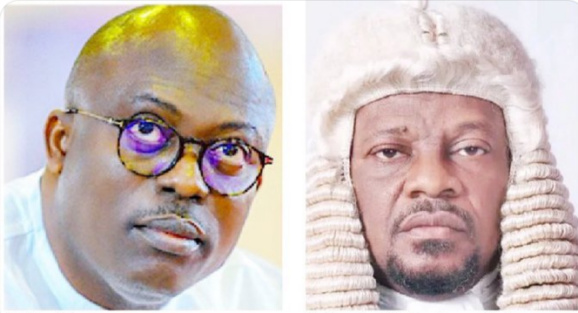
Barely two months after the end of emergency rule in Rivers State restored full democratic operations, the fragile peace between Governor Siminalayi Fubara and the Rivers State House of Assembly has broken once again, igniting a new wave of political tension. The latest clash centres on the deteriorating condition of public schools across the state and accusations exchanged between the executive and legislative arms.
The renewed confrontation comes after President Bola Ahmed Tinubu lifted the six-month emergency rule imposed on Rivers in March 2025, a period during which the governor, his deputy, and all members of the Assembly were suspended. The intervention followed a prolonged and messy power struggle between Governor Fubara and lawmakers loyal to former governor and current FCT Minister, Nyesom Wike.

💰💰Donations can be made into 👇
ToyinOlomo Int’l Foundation FCMB 7616705014
Thank you.
please note that this is a broacast message
Upon the lifting of the emergency order in September 2025, both the governor and the Assembly members were reinstated, sparking public celebration across the state. Many residents hoped the reconciliation would lead to stability, development, and a refocus on governance rather than politics.
However, new cracks appeared last week when the Rivers State House of Assembly, led by Speaker Martins Amaewhule, raised alarm over the deplorable condition of primary and secondary schools. The Assembly’s Education Committee reported shocking findings, including cases where a single teacher handled two classes simultaneously in the same room due to shortage of staff and infrastructure collapse.
- Bournemouth Humiliate Manchester United 3-0 at Old Trafford as Carrick Faces Mounting Pressure
 Bournemouth delivered another painful blow to Manchester United on Sunday,…
- Tragedy in Kogi: Police Corporal Allegedly Kills Female Colleague, Takes Own Life After Reported Relationship Crisis
 A tragic shooting incident involving two serving police officers has…
Speaker Amaewhule accused the Fubara administration of negligence, insisting that basic amenities such as electricity, functional toilets, and security were either absent or poorly maintained in many schools. He described the situation as “embarrassing and unacceptable,” especially in a state that reportedly had about ₦600 billion left in its coffers after the period of emergency rule.
The Speaker further argued that the visible decay in schools was evidence of poor prioritisation by the executive, especially at a time when public education requires urgent intervention to reverse years of decline. He urged the governor to take immediate action rather than make what he called “recycled promises.”
Responding to the allegations, Governor Fubara admitted that many public schools in Rivers State were in dire condition but insisted the problem neither began under his administration nor was it worsened by inaction. He noted that even during his campaign, citizens had openly complained about poor education infrastructure and the state’s long-standing neglect of public school facilities.
Governor Fubara further explained that the prolonged political crisis, including the period of emergency rule, delayed several planned reforms and slowed down capital projects. He assured Rivers people that education would receive the largest allocation in the 2026 state budget, with a focus on rehabilitating dilapidated schools, hiring more teachers, and improving security around learning environments.
Despite the governor’s explanation, the Assembly maintained its stance, insisting that the executive must move beyond rhetoric and immediately deploy funds to address the urgent needs of schoolchildren. According to the lawmakers, the current state of education represents a “looming disaster” that could undermine the future of the state.
The renewed hostilities between the governor and the Assembly have once again raised concerns about the fragile political stability in Rivers State. Analysts warn that unless both sides prioritise governance over factional battles, the state may continue to suffer delays in development projects and essential public services. For residents and parents, the pressing question remains whether the political storm will give way to actual improvements in the state’s decaying school system.