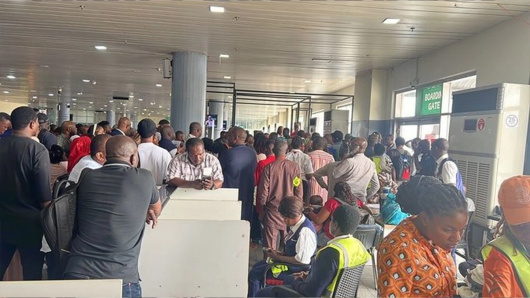
Flight operations were disrupted at major Nigerian airports on Tuesday as aviation unions began industrial action, with union members barricading entrances to terminals operated by Air Peace in Lagos and Abuja. The action left passengers stranded and disrupted scheduled flights across the airline’s network.
The industrial action involves the National Union of Air Transport Employees (NUATE), Air Transport Services Senior Staff Association of Nigeria (ATSSSAN) and National Association of Aircraft Pilots and Engineers (NAAPE), with the unions receiving support from the Nigeria Labour Congress (NLC) and Trade Union Congress (TUC).
The unions are protesting what they described as anti-union practices by some airlines, particularly allegations that workers have been prevented from freely joining trade unions of their choice. They are also demanding the payment of outstanding statutory Ticket Sales Charges owed to aviation regulatory agencies.
At the Murtala Muhammed Airport in Lagos, the unions reportedly barricaded access to Air Peace’s departure facilities, including the Alpha and Zulu terminals at Terminal 1 and Terminal 2. A similar blockade was reported at the airline’s terminal at the Nnamdi Azikiwe International Airport in Abuja.
The action resulted in the suspension of scheduled Air Peace departures from Lagos and Abuja, with numerous passengers unable to access departure areas. Reports from the two airports showed travellers caught up in the industrial dispute as the unions maintained their picketing operations.
One of the major issues behind the dispute is the five per cent Ticket Sales Charge, which the unions and other stakeholders say is required to be remitted to the Nigeria Civil Aviation Authority (NCAA). The unions have accused airlines of failing to remit some of the charges, with the amount allegedly owed by Air Peace put at about N15 billion.
The unions also argue that non-remittance of the charges affects the finances and operations of aviation agencies and could undermine the implementation of negotiated collective bargaining agreements for workers. They are consequently demanding that outstanding revenues be paid and that workers be allowed to exercise their rights to unionise without intimidation or discrimination.
The dispute had been building before Tuesday’s shutdown. The aviation unions reportedly issued a strike notice on August 4 and subsequently gave affected airlines a three-day ultimatum, describing the period as an opportunity for the parties to resolve the disagreements through dialogue.
The situation has prompted intervention from the NCAA, which appealed to the aviation unions to suspend the industrial action. The regulator’s appeal came as the disruption at Lagos and Abuja airports generated concerns about stranded passengers and the wider impact on air transportation.
Air Peace has confirmed that its operations were affected by the picketing, while reports also indicated that vehicles were deployed around the Lagos airport during the confrontation. As negotiations and appeals for a resolution continue, attention remains focused on whether the unions and affected airlines can reach an agreement quickly enough to restore normal flight operations and prevent further disruption to air travellers.
- Dangote Refinery’s N2.15 Trillion IPO Closes Today as Investors Make Final Push
 LAGOS, Nigeria — The highly anticipated initial public offering (IPO)…
Read More “Dangote Refinery’s N2.15 Trillion IPO Closes Today as Investors Make Final Push” »
- NCAA to Probe Airline After Passenger Reportedly Bleeds Amid Extreme Heat on Abuja–Calabar Flight
 The Nigeria Civil Aviation Authority (NCAA) is set to investigate…