

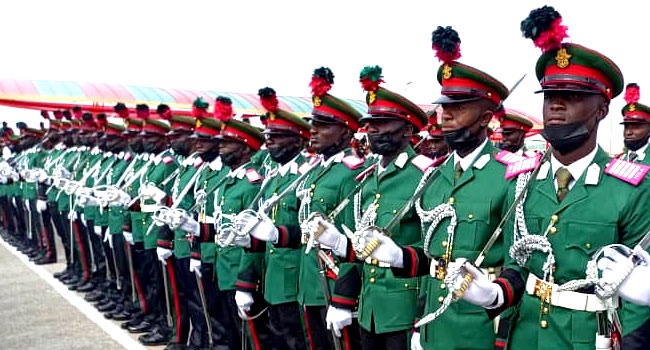
The Nigerian Army has appointed General Officers Commanding (GOCs) to lead its newly created divisions, marking a significant step in the implementation of President Bola Tinubu’s approval for the expansion of the Army from eight to twelve divisions as part of efforts to strengthen the country’s response to growing security challenges.
The appointments follow the Federal Government’s recent approval for the establishment of four additional divisions in Makurdi, Benue State; Ilorin, Kwara State; Jalingo, Taraba State; and Benin City, Edo State, alongside the recruitment of about 28,000 additional personnel to support the enlarged force structure. According to the Presidency, the expansion will be implemented in phases, with three of the new divisions expected to become operational before the end of the third quarter of 2026, while the remaining formation will commence operations later in the year.
The latest appointments are intended to provide leadership for the new formations as the Army restructures its operational architecture to improve command and control, troop deployment and rapid response to security threats across the country.
Nigeria has continued to battle multiple security challenges, including insurgency in the North-East, banditry and kidnapping in the North-West, violent communal conflicts in parts of the North-Central and criminal activities in several southern states. The Army believes that creating additional divisions will decentralise operational command, shorten response times and improve coordination among troops in different theatres of operation.
Former Chief of Defence Staff, General Lucky Irabor (retd.), has described the creation of additional divisions as a strategic decision with far-reaching implications for national security. According to him, expanding the Army’s divisional structure is not merely an administrative exercise but a move that increases operational flexibility, enhances territorial coverage and enables commanders to respond more effectively to evolving security threats. He, however, stressed that the success of the initiative would depend on adequate funding, logistics, personnel welfare, training and sustained political commitment.
Security analysts have similarly observed that the restructuring could improve intelligence coordination and operational efficiency by bringing military command closer to flashpoints, particularly in states facing persistent insecurity. They caution, however, that the new formations must be matched with modern equipment, sufficient manpower and improved inter-agency cooperation to deliver the desired impact.
The appointments of the new General Officers Commanding are expected to pave the way for the full operationalisation of the additional divisions as the Nigerian Army continues its transformation programme aimed at building a larger, more agile and combat-ready force capable of addressing contemporary and emerging security challenges across the federation.
- Nigeria Evacuates First Ebola Patient to Switzerland as Health Minister Confirms Medical Flight
 ABUJA, Nigeria — Nigeria’s first confirmed Ebola patient in more…
- EFCC Raids Four Illegal Lithium Plants in Ogun, Arrests 14 Chinese Nationals and Nigerian
 The Economic and Financial Crimes Commission (EFCC) has arrested 15…