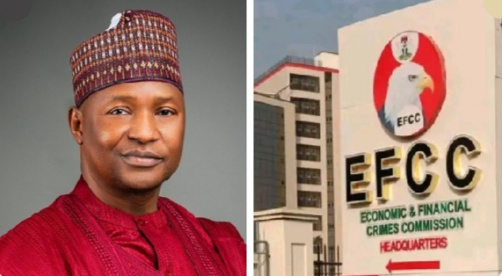





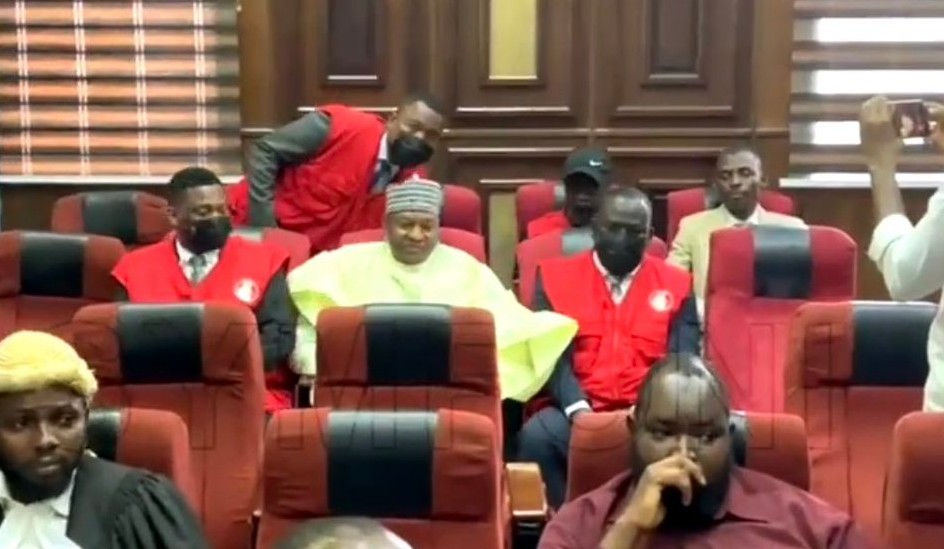
The Economic and Financial Crimes Commission (EFCC) has arraigned Abubakar Malami, SAN, the former Attorney-General of the Federation and Minister of Justice, alongside his son, Abubakar Abdulaziz Malami, and an associate, Bashir Asabe, over allegations of money laundering. The arraignment took place at the Federal High Court in Abuja before Justice Emeka Nwite.
The trio faces a 16-count charge bordering on money laundering, which the EFCC alleges involved the concealment, disguise, and retention of funds acquired through unlawful means. The charges reportedly span activities conducted between 2015 and 2025, coinciding with Malami’s tenure in office under the administration of former President Muhammadu Buhari.
Court filings detail that the accused allegedly used corporate entities and bank accounts to launder billions of naira. For instance, the EFCC claims that Metropolitan Auto Tech Limited was used to conceal over ₦1.01 billion in a Sterling Bank account, one of the first counts of the 16-count charge sheet.
Additional counts accuse the defendants of retaining over ₦600 million through the same company and directing funds as cash collateral for loans obtained by Rayhaan Hotels Ltd, despite knowing that the funds were illicitly sourced. Other counts highlight luxury real estate acquisitions in Abuja, including a duplex in Maitama and properties in Garki, Jabi, and Asokoro, allegedly purchased with unlawfully obtained funds.
- Nigeria’s First Ebola Patient Identified as Wife of Swiss Diplomat as Authorities Probe Source of Infection
 Nigeria’s latest Ebola case has been traced to a 42-year-old…
- MURIC Seeks Police Probe into Alleged Killing of Man Inside Oyo Mosque
 The Muslim Rights Concern (MURIC) has petitioned the police over…
Read More “MURIC Seeks Police Probe into Alleged Killing of Man Inside Oyo Mosque” »
The EFCC’s charge sheet further implicates the defendants in additional property and financial transactions through other corporate fronts and bank accounts, including transactions involving Meethaq Hotels Ltd via Union Bank. The alleged activities are said to contravene provisions of the Money Laundering (Prohibition and Prevention) Acts of 2011 and 2022.
The anti-graft agency’s filings also allege the acquisition of high-value properties in Abuja, Kano, and Kebbi states, using proceeds from purportedly unlawful activities. These properties, some linked to hotels and businesses, form the core of the EFCC’s money-laundering claims.
The arraignment represents a pivotal moment in Nigeria’s fight against corruption, particularly in cases involving high-profile former officials. Observers note that the charges against Malami have significant political and legal implications, given his previous role as the nation’s chief law officer.
During the court proceedings, the defendants were expected to enter their pleas to the charges, while the court will determine the next steps, including potential bail applications and trial scheduling. Legal experts indicate that the case could take months to reach resolution due to the complex nature of the alleged financial transactions.
The case has drawn widespread public attention, with civil society groups and commentators emphasizing the need for accountability in high-level corruption cases. The EFCC has been under pressure to demonstrate the effectiveness of anti-corruption laws, and this arraignment marks a high-profile enforcement of these statutes.
As Nigeria watches closely, the outcome of this case could set a precedent for handling money laundering allegations against former government officials, reinforcing the country’s commitment to transparency, accountability, and the rule of law.