

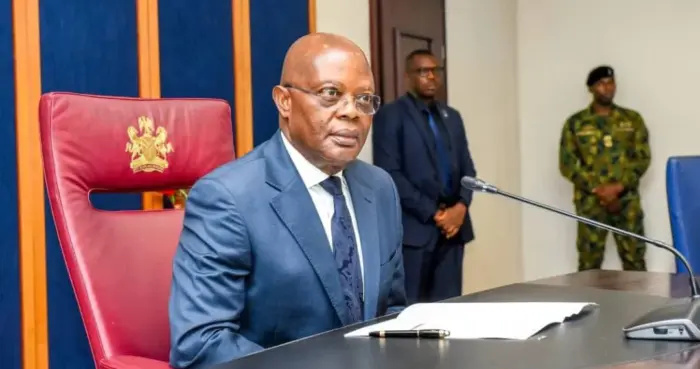
PORT HARCOURT, Nigeria — A political storm is brewing in Rivers State as the immediate past sole administrator, Vice Admiral Ibok-Ete Ibas (retd.), has rejected plans by the Rivers State House of Assembly to investigate how billions of naira were spent during the six-month emergency rule that ended last week.
The Assembly, led by Speaker Martin Amaewhule, resumed plenary on Monday for the first time since President Bola Tinubu lifted the emergency on September 17, 2025. Lawmakers resolved to probe all expenditures made under Ibas, citing the need to “explore the process of knowing what transpired during the emergency rule with regard to spending from the consolidated revenue fund for the award of contracts and other expenditure.”
Ibas Pushes Back
Sources close to the retired naval chief confirmed that Ibas has described the planned probe as “politically motivated” and unnecessary, insisting that all spending during his tenure followed due process. He has reportedly vowed to resist any attempt to “malign his integrity” or “rewrite the record” of his administration.
Ibas was appointed sole administrator on March 18, 2025, after President Tinubu declared a state of emergency in Rivers State, suspending Governor Siminalayi Fubara, his deputy Ngozi Odu, and all members of the state House of Assembly. According to the presidency, the emergency was declared under Section 305 of the 1999 Constitution to quell a prolonged power tussle between Fubara and his predecessor, Nyesom Wike.
N254.37bn FAAC Inflows Under Scrutiny
At the heart of the probe is the staggering N254.37 billion Rivers State received from the Federation Account Allocation Committee (FAAC) between March and August 2025, according to a review of National Bureau of Statistics (NBS) data and FAAC documents.
- Tottenham Stun Chelsea at Stamford Bridge as Palmer Sees Red and Maddison Suffers Fresh Injury Blow
 Tottenham Hotspur delivered a statement victory over London rivals Chelsea…
- AFCOM-HS: New Military Medical College Listed on JAMB Portal for 2026/2027 Admission
 The Armed Forces College of Medicine and Health Sciences (AFCOM-HS),…
Read More “AFCOM-HS: New Military Medical College Listed on JAMB Portal for 2026/2027 Admission” »
Monthly Breakdown:
Rivers collected N44.66bn in March, N44.42bn in April, N42.80bn in May, N42.30bn in June, N38.42bn in July, and N41.76bn in August — averaging N42.40bn per month.
Oil Derivation Dominance: The 13% oil derivation accounted for N133.24bn (52.4% of total allocations), underscoring the state’s dependence on volatile oil-linked revenue streams.
Debt Deductions: External debt servicing consumed N26.31bn, with an average monthly deduction of N4.56bn from March to July and N3.54bn in August.
VAT Cushion: Value Added Tax (VAT) receipts contributed N107.78bn (42.4% of allocations), helping to offset debt and other deductions.
Despite these inflows, Rivers State has not published its 2025 Budget Implementation Report, a statutory document detailing how revenues and expenditures were managed. Civil society groups argue this omission fuels suspicion of financial mismanagement.
Civil Society Demands Transparency
Chairman of the Coalition of Civil Society Organisations in Rivers State, Enefaa Georgewill, said the absence of public spending records “deepens suspicion of mismanagement.”
“Most major projects, including the Rivers State House of Assembly Complex, remain stalled despite the heavy inflows,” Georgewill told reporters, urging the Assembly to “ensure every kobo is accounted for.”
Political Context
The six-month emergency rule followed nearly two years of political instability marked by a bitter feud between Governor Fubara and former Governor Wike. Although the Supreme Court is yet to rule on a challenge to the emergency declaration (case SC/CV/329/2025), a reconciliation between Wike and Fubara paved the way for the lifting of the emergency and the resumption of democratic governance.
The state held local government elections on August 30, with the All Progressives Congress (APC) winning 20 seats and the Peoples Democratic Party (PDP) taking three.
What’s Next?
The Assembly is expected to set up an investigative committee in the coming days to review financial records from March to September 2025. Analysts warn the inquiry could trigger another round of political tension if Ibas refuses to cooperate or if findings implicate top officials in alleged mismanagement.
As the probe looms, residents and watchdog groups say the outcome will be a crucial test of accountability in a state whose economy is heavily reliant on oil but plagued by governance crises.