





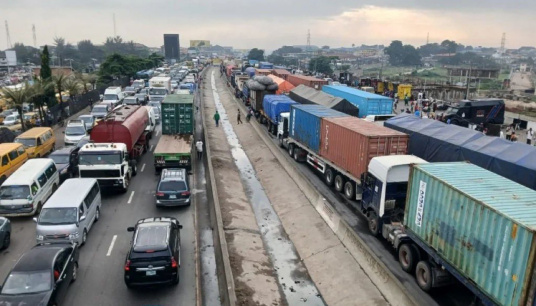
A fresh wave of multiple road crashes around the Kara Bridge section of the Lagos-Ibadan Expressway has triggered severe traffic congestion, leaving thousands of motorists and commuters stranded along one of Nigeria’s busiest transport corridors.
The latest disruption, reported on Friday, July 24, 2026, came after separate overnight crashes occurred on both the Lagos-bound and Ibadan-bound carriageways around the Kara axis. The incidents reportedly involved several articulated trucks and other vehicles, compounding an already difficult traffic situation in the corridor.
According to reports citing the Federal Road Safety Corps (FRSC), one of the crashes occurred at about 12:05 a.m. on the outbound carriageway towards Ibadan and involved five articulated trucks and a Toyota Sienna bus. Preliminary findings reportedly linked the incident to excessive speed and loss of control.
Another crash was reported on the opposite carriageway and involved a Mazda commercial bus and other vehicles. The series of collisions reportedly resulted in at least one confirmed death and injuries to two other people.
The situation was further complicated by recovery operations. Emergency responders faced difficulties removing damaged vehicles and clearing the affected sections of the highway, with reports indicating that specialised equipment was required to recover a victim trapped beneath a heavily loaded articulated truck.
As the emergency response continued, traffic movement through the Kara-Ojodu Berger corridor deteriorated significantly, leaving large numbers of commuters caught in lengthy queues.
The FRSC subsequently advised motorists to consider alternative routes where possible, while emergency and traffic-management agencies worked to clear the wreckage and restore normal movement.
A Recurring Crisis at a Critical Gateway
The latest incident is more than another isolated traffic story. The Kara Bridge axis has, over the years, become a recurring pressure point on the Lagos-Ibadan Expressway, a major economic artery connecting Lagos to Ogun State and the wider South-West and northern parts of Nigeria.
The importance of the route means that even a single major crash can have consequences far beyond the immediate accident scene. When a truck overturns or multiple vehicles collide on the highway, recovery operations can quickly reduce available lanes, creating a chain reaction of congestion that spreads several kilometres away from the original incident.
That vulnerability has been demonstrated repeatedly. In the days preceding the latest multiple crashes, another truck accident around the Kara Bridge area reportedly caused extensive congestion, with motorists travelling towards Ogun State experiencing hours of delays. The incident involved a 40-foot trailer laden with bags of flour, which reportedly overturned after hitting the side rail of the bridge. Preliminary findings attributed that crash to overloading and loss of control.
The recurrence of such incidents raises questions about the broader safety challenges confronting the corridor.
Beyond the Immediate Crash
While individual accidents may be attributed to factors such as speeding, overloading, mechanical failure or loss of control, the repeated disruption at Kara points to a more complex transportation problem.
The corridor carries a heavy mix of passenger vehicles, commercial buses and articulated trucks. This combination creates a particularly challenging operating environment, especially when a breakdown or collision occurs at a strategic bottleneck such as a bridge.
The consequences are not limited to lost travel time. Extended traffic jams can disrupt businesses, delay workers and students, interfere with emergency movements and increase the economic cost of transporting goods between Lagos and other parts of the country.
The situation also highlights the importance of rapid incident management. The difference between a manageable traffic disruption and a highway-wide gridlock can depend heavily on how quickly emergency agencies can secure a crash scene, evacuate casualties, remove disabled vehicles and reopen lanes.
The Need for a Preventive Approach
The continuing pattern of serious crashes around the Kara axis should prompt authorities to look beyond emergency response and examine preventive measures.
There is a need for stronger enforcement of roadworthiness standards, closer monitoring of articulated vehicles, effective control of overloading and more rigorous compliance with speed regulations. Truck operators and drivers also have a critical responsibility to ensure that vehicles are properly maintained and that drivers are adequately rested and trained.
At the same time, the authorities must continue to examine the physical condition and operational design of the corridor. Where ongoing repairs or narrowed sections coincide with heavy traffic, appropriate traffic-management measures and clear advance warnings become essential.
The latest gridlock is therefore a reminder that the safety of the Lagos-Ibadan Expressway cannot depend solely on the actions of motorists or the efforts of first responders after crashes occur. It requires a coordinated strategy involving road infrastructure, enforcement agencies, transport operators and road users.
For motorists caught in Friday’s gridlock, however, these broader questions offer little immediate relief. Their experience is a familiar one: a journey that should take a fraction of the day transformed into hours of uncertainty because a few crashes brought a vital national highway close to a standstill.
The recurring events at Kara should therefore be treated not merely as isolated traffic incidents but as a warning about the fragility of one of Nigeria’s most important transportation corridors. Every major crash that produces another prolonged gridlock presents an opportunity for authorities to reassess what can be done before the next one occurs.
- Troops, DSS Rescue Six Kidnap Victims in Kogi, Including Naval Officer
 Troops of Operation Whirl Stroke (OPWS), working alongside operatives of…
Read More “Troops, DSS Rescue Six Kidnap Victims in Kogi, Including Naval Officer” »
- Dangote Refinery’s N2.15 Trillion IPO Closes Today as Investors Make Final Push
 LAGOS, Nigeria — The highly anticipated initial public offering (IPO)…
Read More “Dangote Refinery’s N2.15 Trillion IPO Closes Today as Investors Make Final Push” »


