








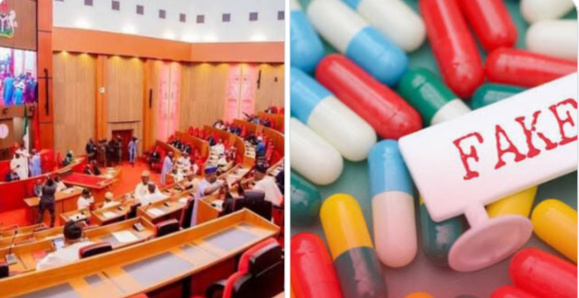
Nigeria’s Senate has passed for second reading a bill seeking to significantly strengthen the country’s legal framework against counterfeit medicines, fake drugs and unsafe processed food products, proposing stiffer penalties that include up to 15 years’ imprisonment for individuals caught hawking medicines.
The proposed legislation, titled the Counterfeit Medical Products, Fake Drugs and Unwholesome Processed Foods (Prohibition and Control) Bill, 2026 (SB.951), is sponsored by Senator Umar Suleiman, who represents Kwara North Senatorial District. The bill is aimed at replacing the existing law with a more robust legal regime capable of addressing modern challenges such as online drug sales, cross-border trafficking and increasingly sophisticated counterfeit operations.
Leading the debate on the Senate floor, Senator Suleiman argued that the current legislation has become outdated and is no longer sufficient to combat the evolving activities of counterfeit drug syndicates. He said the proposed law seeks to better protect Nigerians from preventable deaths and health complications linked to fake medicines while strengthening confidence in the country’s healthcare system.
Under the bill, offences including the production, importation, manufacture, transportation, distribution, sale and possession of counterfeit medical products and unwholesome processed foods would attract stricter punishments. The legislation also criminalises the production and possession of counterfeit labels, packaging materials and equipment used in manufacturing fake products.
One of the bill’s major provisions prohibits the sale and hawking of medicines in unauthorised locations such as open markets, motor parks, roadside stalls, buses, ferries and unlicensed online platforms. Convicted offenders could face up to 15 years in prison, substantial fines, compensation to victims or their families, forfeiture of assets connected to the offences, and sanctions against corporate organisations involved in such activities.
The proposed legislation also seeks to strengthen the enforcement powers of the National Agency for Food and Drug Administration and Control (NAFDAC), authorising the agency to deploy modern product-tracking technologies, conduct inspections, seize counterfeit goods, arrest suspects, seal offending premises and intensify surveillance at Nigeria’s ports of entry. It further grants the Federal High Court exclusive jurisdiction over offences arising under the proposed law while providing for accelerated prosecution of cases.
Several senators expressed support for the measure, describing counterfeit medicines as a major public health threat responsible for avoidable deaths across the country. However, some lawmakers urged the Senate Committee on Health to clarify the relationship between the proposed legislation and the existing NAFDAC Act to avoid duplication of regulatory responsibilities.
Following its successful second reading, the bill was referred to the Senate Committee on Health (Secondary and Tertiary), which has been given four weeks to conduct further legislative scrutiny and submit its report to the Senate for consideration.
- Dangote Refinery’s N2.15 Trillion IPO Closes Today as Investors Make Final Push
 LAGOS, Nigeria — The highly anticipated initial public offering (IPO)…
Read More “Dangote Refinery’s N2.15 Trillion IPO Closes Today as Investors Make Final Push” »
- NCAA to Probe Airline After Passenger Reportedly Bleeds Amid Extreme Heat on Abuja–Calabar Flight
 The Nigeria Civil Aviation Authority (NCAA) is set to investigate…