







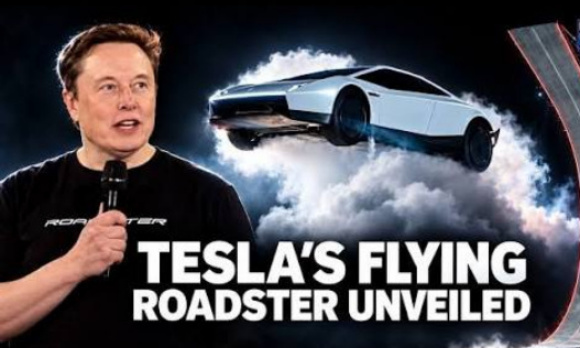
Tesla has unveiled a futuristic version of its long-awaited Roadster sports car, featuring rocket-style thrusters that allow the vehicle to perform dramatic airborne manoeuvres, reigniting public interest in the possibility of flying cars.
The demonstration took place on Thursday, October 15, 2026, at a SpaceX testing facility in Texas, United States, where Tesla Chief Executive Officer Elon Musk showcased the vehicle’s unusual capabilities. The event was livestreamed, drawing attention to what Musk described as a glimpse into the future of transportation.
Unlike conventional electric vehicles, the new Roadster incorporates cold-gas propulsion technology developed in collaboration with SpaceX. The system uses highly pressurised gas to generate thrust, enabling the vehicle to lift briefly off the ground and execute aerial movements that would be impossible for an ordinary road car.
During the demonstration, the vehicle moved along a specially constructed ramp before launching into the air and rotating approximately 180 degrees before landing on its wheels. The display also featured a section of the ramp that allowed the car to travel upside down briefly, creating the impression that it was defying gravity.
However, the demonstration does not mean Tesla has developed a conventional flying car capable of sustained flight. Aviation experts have cautioned that the vehicle’s ability to leave the ground briefly is different from operating as an aircraft. The technology’s practical application would depend on further engineering development, safety testing and regulatory approval.
Musk said the vehicle was demonstrated without a human occupant for safety reasons, acknowledging the risks associated with the experimental technology. The disclosure highlights the gap between the spectacular performance presented during the launch and the safety standards required before such a vehicle could be used routinely by consumers.
Beyond its airborne features, Tesla has presented the Roadster as a high-performance electric sports car. Reported specifications include acceleration from zero to 60 miles per hour in less than one second and a top speed exceeding 230 miles per hour. These figures are manufacturer-related claims and should be distinguished from independently verified performance results.
Despite the attention generated by the unveiling, prospective buyers will have to wait. Tesla is targeting 2028 for production, meaning the vehicle is not yet available as a finished, mass-produced car. The company has also not finalised all the details surrounding its price, specifications and eventual delivery schedule.
The proposed vehicle also faces legal and regulatory challenges. A car designed to travel on public roads cannot automatically be used as an aircraft simply because it can leave the ground. Depending on its final design and intended operation, aviation certification, safety requirements and restrictions governing where it may operate could limit its practical use.
For Tesla, the Roadster unveiling represents more than an attempt to produce an unusual sports car. It reinforces the company’s reputation for ambitious engineering and futuristic product concepts at a time when its broader business is increasingly focused on autonomous driving, artificial intelligence and robotics. Nevertheless, the commercial value of the new Roadster will ultimately depend on whether Tesla can turn the impressive demonstration into a safe, functional and deliverable product.
For now, Tesla’s so-called flying car remains an experimental step towards a long-standing transportation dream rather than a practical alternative to conventional cars or aircraft. While the demonstration has shown that a road vehicle can perform brief, controlled airborne manoeuvres using specialised propulsion technology, sustained flight, public-road legality and commercial availability remain separate challenges. Whether the Roadster can move beyond spectacle to become a viable consumer vehicle will become clearer as Tesla approaches its targeted production date.
- Tinubu Flags Off $100m Southeast Gas Pipeline Project to Boost Industrial Growth
 President Bola Tinubu has flagged off a $100 million gas…
Read More “Tinubu Flags Off $100m Southeast Gas Pipeline Project to Boost Industrial Growth” »
- NCC Raises Alarm Over AI-Powered Cyberattacks, Warns of Threats to Telecoms, Banks and National Security
 The Nigerian Communications Commission (NCC) has warned that the growing…


