





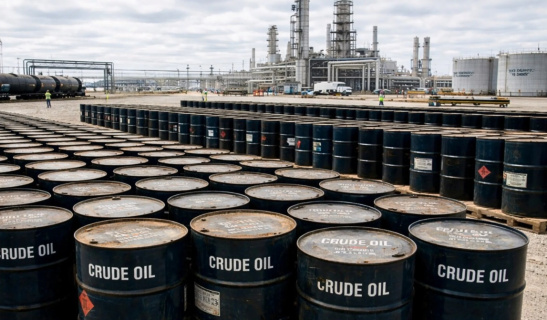
Nigeria generated an estimated ₦24.02 trillion from crude oil exports in the first half of 2026, with approximately 182.2 million barrels of crude shipped to international markets during the six-month period.
The figures, now circulating in industry and media reports, underline the continuing importance of crude oil to Nigeria’s foreign-exchange earnings and fiscal position, even as the country attempts to diversify its economy and expand domestic refining capacity.
Available estimates put the value of the exported crude at about $17.6 billion, meaning the average export volume was approximately 1.0 million barrels per day between January and June. The reported figures should, however, be regarded as estimates pending a definitive consolidated government release covering the entire first half of the year.
Production recovery strengthens export capacity
The export performance comes against the backdrop of a marked improvement in Nigeria’s upstream oil production during the first half of 2026.
Data from the Nigerian Upstream Petroleum Regulatory Commission (NUPRC) show that combined crude oil and condensate production rose steadily during the first six months of the year. By June, average production had reached 1.735 million barrels per day, comprising approximately 1.56 million barrels per day of crude oil and 0.18 million barrels per day of condensates.
NUPRC described the June crude production figure as the highest Nigeria had recorded in 74 months and said the country had achieved 104 per cent of its 1.5 million barrels-per-day OPEC crude production quota.
The improvement was attributed largely to greater operational stability across producing assets, fewer major pipeline disruptions and better crude evacuation efficiency.
Production had risen from about 1.483 million barrels per day in February to 1.546 million in March, 1.663 million in April, 1.700 million in May and 1.735 million barrels per day in June when crude and condensates were combined.
That recovery is important because Nigeria’s ability to benefit from higher international oil prices ultimately depends not only on the price of crude but also on how many barrels the country can reliably produce and sell.
What the 182.2 million barrels means
The reported 182.2 million barrels exported during the first half of 2026 translates to an average of roughly 1.0 million barrels per day.
That is a substantial export volume, but it should not be confused with total national crude production.
For perspective, the reported first-half production estimate of approximately 263.65 million barrels means that roughly seven out of every ten barrels produced during the period were reportedly directed to export markets, based on the figures currently circulating.
The distinction matters.
Nigeria produces crude for several purposes, including export, domestic refining and other industry requirements. Therefore, the value of crude exports cannot be treated as equivalent to the government’s total petroleum income or as money that flows directly into government coffers.
Oil sales generate revenue for different participants in the petroleum value chain, including producers, joint-venture partners and government entities, while government receipts are affected by production-sharing arrangements, royalties, taxes, costs, equity interests and other fiscal provisions.
The ₦24.02 trillion headline requires context
The ₦24.02 trillion figure is undoubtedly eye-catching, particularly against Nigeria’s broader fiscal pressures.
At face value, it suggests an average export value of roughly ₦132,000 per exported barrel.
But the headline figure should not be interpreted as ₦24.02 trillion in free cash available to the Federal Government.
The distinction between gross export value and government revenue is fundamental to understanding Nigeria’s petroleum economy.
Gross crude export value represents the estimated market value of the barrels sold. Government revenue, on the other hand, is the amount ultimately accruing to public coffers after accounting for the applicable fiscal arrangements and other deductions.
This is one reason why spectacular oil-export numbers do not automatically translate into corresponding improvements in public services, infrastructure spending or household incomes.
Higher production offers Nigeria an opportunity
The more encouraging aspect of the latest figures is not simply the amount of crude exported but the evidence of improving production.
For years, Nigeria’s oil sector has struggled with a combination of underinvestment, ageing infrastructure, crude theft, pipeline disruptions, insecurity and operational challenges.
The recent production trajectory suggests that some of those constraints are being addressed.
NUPRC’s June data indicate that the country’s crude production has been increasing for four consecutive months. The commission specifically linked the improvement to stable operations and the absence of major pipeline outages during the month.
The country’s official petroleum reserves also remain substantial. NUPRC reported 37.01 billion barrels of combined oil and condensate reserves as of January 1, 2026, alongside 215.19 trillion cubic feet of gas reserves.
The challenge, therefore, is increasingly one of turning reserves into sustainable production and converting petroleum wealth into broader economic value.
The refinery paradox
Perhaps the most important question arising from the export figures is not how much Nigeria sold abroad, but how effectively the country is balancing exports with domestic crude supply.
Nigeria has invested heavily in developing domestic refining capacity, with the objective of reducing dependence on imported petroleum products and retaining more value from its crude within the country.
Yet domestic crude supply remains a major issue.
NUPRC data reported in May showed that Nigerian refineries received only 28.5 million barrels of crude during the first quarter of 2026, despite producers offering substantially more crude under the Domestic Crude Supply Obligation framework. The regulator attributed the shortfall largely to persistent supply challenges, including disagreements over pricing.
That creates an uncomfortable policy question.
If Nigeria can export more than 180 million barrels in six months, can it simultaneously guarantee sufficient competitively priced crude for domestic refineries?
The answer will determine whether the country’s expanding refining infrastructure can deliver its full economic promise.
Exporting crude remains necessary — but exporting value matters more
There is nothing inherently contradictory about Nigeria exporting crude while developing domestic refining.
Crude exports provide foreign exchange and remain an important source of national income. Nigeria’s oil industry also operates within an international market in which crude is traded globally.
The strategic question is therefore not whether Nigeria should export crude, but how much additional value the country can retain from every barrel produced.
A barrel exported in its raw form generates one level of economic value. A barrel processed domestically into petrol, diesel, aviation fuel, petrochemicals and other products potentially supports a much wider industrial ecosystem.
Domestic refining can also create jobs, strengthen related industries, reduce import dependence and potentially improve Nigeria’s trade balance.
That makes the current period particularly important for petroleum-sector policy.
A warning against complacency
The latest export figures are positive, but they should not encourage another cycle of dependence on crude oil as the answer to every economic problem.
Nigeria remains vulnerable to international oil-price movements. A rise in production can increase export earnings when prices are favourable, but a sharp fall in global prices can quickly weaken the value of those exports.
There is also the longer-term challenge posed by the global energy transition.
Nigeria therefore has an opportunity to use stronger oil-sector performance as a platform for economic transformation rather than merely as a source of recurrent government revenue.
The country could channel improved petroleum receipts into infrastructure, human capital, electricity, industrialisation, technology and other productive sectors capable of generating wealth after the era of easy oil revenues becomes less certain.
The bigger picture
The estimated 182.2 million barrels exported for ₦24.02 trillion in the first half of 2026 is more than another impressive petroleum statistic.
It is a snapshot of a Nigerian economy still deeply connected to crude oil, even while attempting to build a more diversified future.
The production recovery demonstrated by the NUPRC figures is encouraging. Nigeria has shown that operational improvements can unlock additional barrels. The next test is whether those additional barrels can translate into durable economic gains.
For the Federal Government, the priority should be clear: protect production gains, attract fresh investment into the upstream sector, improve transparency in petroleum revenues, enforce domestic crude-supply obligations fairly, and ensure that expanding refining capacity becomes commercially sustainable.
For Nigerians, the ultimate measure of success should be more demanding than the number displayed on an oil-export headline.
The real question is whether billions of dollars generated from the country’s natural resources translate into better infrastructure, stronger industries, more productive jobs and improved living standards.
Nigeria has exported millions of barrels.
The greater challenge is to ensure that the wealth created by those barrels does not simply leave the country as crude, while the economic opportunities associated with them remain unrealised at home.
- Tottenham Stun Chelsea at Stamford Bridge as Palmer Sees Red and Maddison Suffers Fresh Injury Blow
 Tottenham Hotspur delivered a statement victory over London rivals Chelsea…
- AFCOM-HS: New Military Medical College Listed on JAMB Portal for 2026/2027 Admission
 The Armed Forces College of Medicine and Health Sciences (AFCOM-HS),…
Read More “AFCOM-HS: New Military Medical College Listed on JAMB Portal for 2026/2027 Admission” »