







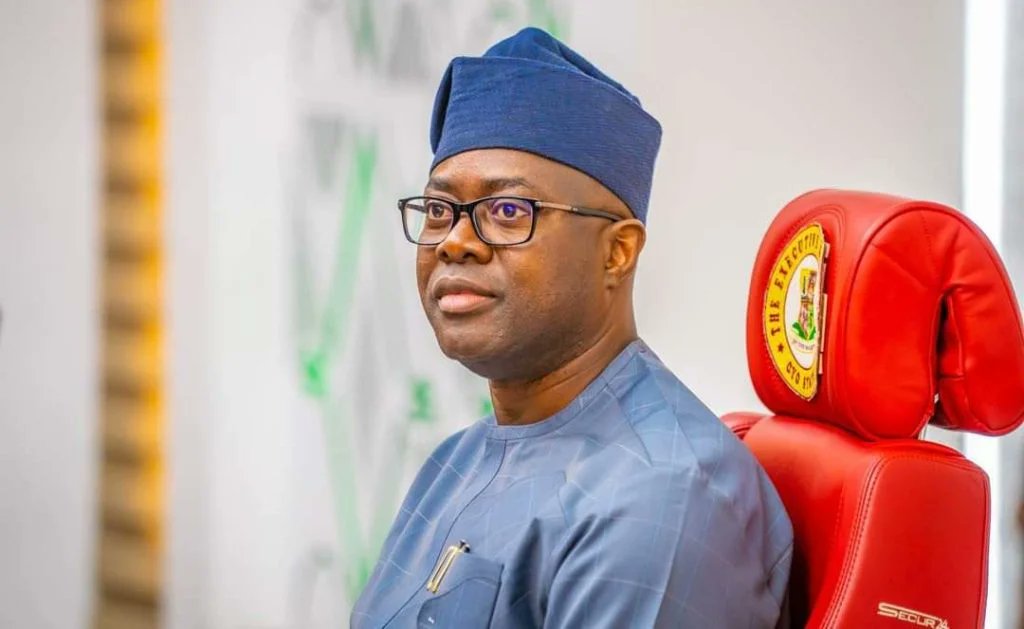
The Alaafin of Oyo, Oba Abimbola Akeem Owoade I, has publicly challenged Oyo State Governor Seyi Makinde’s assertion that he was consulted before the introduction of a rotational leadership arrangement for the Oyo State Council of Obas and Chiefs, igniting fresh controversy around the governance of traditional institutions in the state.
The disagreement followed the re-inauguration of the Oyo State Council of Obas and Chiefs in Ibadan, where Governor Makinde announced that the chairmanship of the council would henceforth rotate every two years among the Olubadan of Ibadanland, the Alaafin of Oyo, and the Soun of Ogbomosoland. The governor also inaugurated the Olubadan of Ibadanland, Oba Rashidi Ladoja (Arusa I), as the council’s chairman under the new arrangement.
Governor Makinde stated at the event that the decision on rotational leadership was reached after consultations with the three foremost traditional rulers in the state, presenting the move as a consensus-driven reform aimed at fairness and inclusivity within the traditional council.
However, in a swift and firm response, the Alaafin’s Palace issued a statement rejecting the governor’s claim, insisting that no such consultation ever took place. The statement was signed by Bode Durojaiye, Director of Media and Publicity to the Alaafin, and described the governor’s remarks as inaccurate.
According to the palace, there was no meeting at any time between the Alaafin and Governor Makinde, nor with the Olubadan or the Soun of Ogbomosoland, regarding the leadership or rotational chairmanship of the council. The palace stressed that the Alaafin neither endorsed nor discussed the arrangement now being implemented.
The statement further clarified that the Alaafin did not make any public or private declaration supporting the rotational leadership formula, directly contradicting impressions created by the governor’s comments at the inauguration ceremony.
- Nigeria’s First Ebola Patient Identified as Wife of Swiss Diplomat as Authorities Probe Source of Infection
 Nigeria’s latest Ebola case has been traced to a 42-year-old…
- MURIC Seeks Police Probe into Alleged Killing of Man Inside Oyo Mosque
 The Muslim Rights Concern (MURIC) has petitioned the police over…
Read More “MURIC Seeks Police Probe into Alleged Killing of Man Inside Oyo Mosque” »
Notably, the Alaafin was absent from the re-inauguration event, a development that had already raised questions among observers about possible dissent within the traditional hierarchy before the palace’s official response confirmed the disagreement.
The palace also revealed that its position on the matter had earlier been formally communicated to the state government through a memorandum submitted by the Oyo Council of Elders, suggesting that the governor was already aware of the Alaafin’s stance before the public announcement.
The dispute has drawn attention to long-standing sensitivities surrounding traditional authority and historical hierarchy in Oyo State, where the Alaafin’s stool is regarded as one of the most influential and symbolically significant in Yorubaland.
While the state government has yet to issue a detailed response to the Alaafin’s denial, the development has sparked widespread debate across the state, with many awaiting clarification on how the disagreement may affect the functioning and unity of the Council of Obas and Chiefs going forward.