





A major pharmaceutical fraud investigation has erupted in Lagos after police uncovered warehouses allegedly being used to repackage suspected counterfeit and adulterated medicines for distribution across Nigeria and beyond.
The operation was carried out by operatives of the Lagos State Police Command’s Violent Crime Response Unit following intelligence concerning the activities of a suspected drug-trafficking syndicate. Two men, identified by the police as 52-year-old Eze Okwudilichukwu and 42-year-old Chukwudi Mba, were arrested in connection with the alleged operation.
According to the police, the suspects were apprehended at a warehouse located at 7A Otto Causeway, Otto, Lagos, where detectives allegedly found them repackaging suspected adulterated pharmaceutical products. The products were reportedly intended for distribution to different parts of Nigeria.
Following the arrests and subsequent interrogation, police said the suspects led detectives to another warehouse. A search warrant was executed at the second location, where officers reportedly recovered a truck loaded with large quantities of suspected adulterated pharmaceutical products.
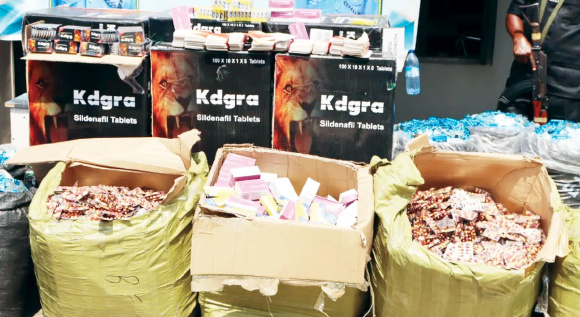
The reported haul included about 300 cartons of suspected adulterated Omeprazole, as well as six bags containing unpackaged suspected adulterated Viagra, Ampiclox, Septrin, Piriton and other pharmaceutical products. Police also reported recovering additional cartons of suspected adulterated Ampiclox, Viagra and other medicines.
More than 300 empty printed packs and cartons allegedly used in the repackaging process were also reportedly recovered. Police said their investigation indicated that the suspected syndicate had operated for more than two years, moving pharmaceutical products to different parts of Nigeria and allegedly sending substantial quantities towards Lomé, Togo.
The discovery has once again exposed the serious public-health risks associated with the illegal pharmaceutical trade. Counterfeit, falsified, adulterated or improperly handled medicines can pose significant dangers to consumers, particularly when products are deliberately repackaged to appear legitimate before being returned to the distribution chain.
The latest operation comes against the backdrop of wider enforcement efforts by Nigerian authorities against counterfeit, expired, unregistered and substandard medical products. NAFDAC has separately reported major seizures of illegal pharmaceutical products in Lagos and other parts of the country, underscoring the scale of the challenge confronting regulators and law-enforcement agencies.
The Lagos police investigation is expected to focus on the source of the suspected medicines, the people allegedly involved in their repackaging and distribution, and the wider network through which the products were reportedly moved. Authorities will also need to establish through appropriate regulatory and forensic processes the precise status and composition of the seized medicines.
For consumers, the development is a stark reminder of the importance of obtaining medicines through legitimate and regulated channels and checking pharmaceutical products carefully before use. Meanwhile, the arrests and seizures remain part of an ongoing investigation, and the suspects are entitled to due process unless and until a court determines otherwise.
- Dangote Refinery’s N2.15 Trillion IPO Closes Today as Investors Make Final Push
 LAGOS, Nigeria — The highly anticipated initial public offering (IPO)…
Read More “Dangote Refinery’s N2.15 Trillion IPO Closes Today as Investors Make Final Push” »
- NCAA to Probe Airline After Passenger Reportedly Bleeds Amid Extreme Heat on Abuja–Calabar Flight
 The Nigeria Civil Aviation Authority (NCAA) is set to investigate…