



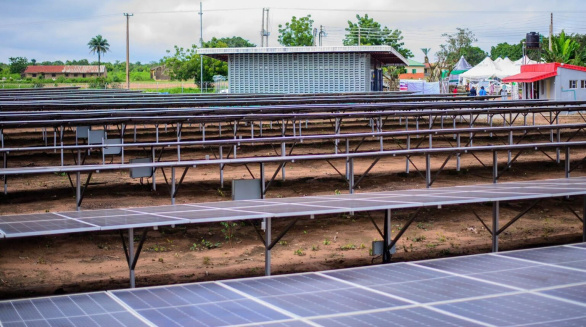
The Federal Government has taken another step towards expanding reliable and sustainable electricity access in underserved communities with the commissioning of a 581-kilowatt-peak (kWp) solar mini-grid in Oke-Oyi, Ilorin East Local Government Area of Kwara State.
Commissioned on September 24, 2026, the project features a 1.4-megawatt battery energy storage system designed to store solar-generated electricity for use beyond periods of sunlight. The intervention is expected to provide improved electricity access to approximately 1,800 households and businesses within the community.
The project was delivered under the Rural Electrification Fund–Interconnected Mini-Grid Acceleration Scheme (REF-IMAS), an initiative of the Federal Government through the Rural Electrification Agency (REA) aimed at accelerating electricity access through decentralised renewable-energy solutions.
According to the REA, the Oke-Oyi facility comprises 1,336 solar panels and 84 batteries, supported by about 10 kilometres of distribution cables and transformers. The infrastructure is designed to serve a community of approximately 13,000 people, connecting homes and productive enterprises to a more dependable source of electricity.
The substantial battery storage component is one of the notable features of the project. By storing electricity generated during the day, the system can extend power availability beyond daylight hours, addressing one of the key limitations associated with solar energy and providing households and businesses with greater predictability in their daily activities.
Beyond lighting homes, the project is already contributing to economic activity in Oke-Oyi. The REA reported the emergence of businesses including welding enterprises, grain mills, aluminium workshops, pure-water producers, an ice-block producer and a cold-room/ice-fish business following the deployment of the electricity infrastructure.
These developments underline the wider economic importance of rural electrification. Reliable power can reduce dependence on costly alternative sources of electricity while allowing small enterprises to operate equipment for longer periods, increase productivity and potentially create additional employment opportunities.
The project also provided temporary employment for members of the host community during its construction. Residents participated in activities including welding, painting, bricklaying, plumbing, tiling, iron bending, borehole digging and excavation, demonstrating how infrastructure investment can generate economic opportunities even before the facilities become fully operational.
The Oke-Oyi project was implemented through collaboration among the Federal Ministry of Power, the Rural Electrification Agency, the Kwara State Government, Ibadan Electricity Distribution Company and Nayo Tropical Technologies Limited, with support from international development partners including the European Union and Germany through GIZ.
For the Federal Government, the intervention represents part of a broader effort to use renewable energy and decentralised electricity systems to address gaps in Nigeria’s power supply. Interconnected mini-grids offer a model through which communities can benefit from locally generated electricity while maintaining a relationship with the existing distribution network.
The commissioning, however, marks the beginning rather than the conclusion of the project’s impact. Sustaining the investment will require effective maintenance, responsible energy consumption, protection of the infrastructure and continued cooperation among the government, operators and the beneficiary community. If properly managed, the Oke-Oyi project could demonstrate how targeted renewable-energy investments can translate government policy into tangible improvements in household welfare, local enterprise and community development.
For the people of Oke-Oyi, the significance of the project is ultimately measured not by its installed capacity or number of solar panels, but by what dependable electricity makes possible: longer business hours, productive enterprises, improved household convenience and new opportunities for economic activity. In that sense, the 581kWp solar mini-grid represents another practical expression of the Federal Government’s drive to expand electricity access and support development through cleaner and more resilient energy infrastructure.
- Bournemouth Humiliate Manchester United 3-0 at Old Trafford as Carrick Faces Mounting Pressure
 Bournemouth delivered another painful blow to Manchester United on Sunday,…
- Tragedy in Kogi: Police Corporal Allegedly Kills Female Colleague, Takes Own Life After Reported Relationship Crisis
 A tragic shooting incident involving two serving police officers has…