

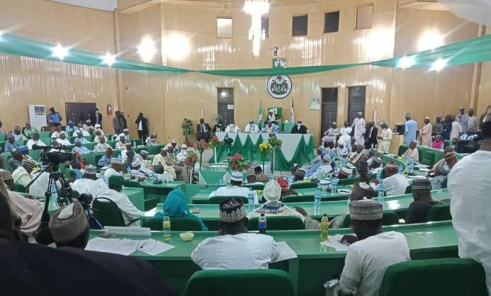
The Kano State House of Assembly has called for the immediate cancellation of the recently announced Nigeria Customs Service (NCS) recruitment exercise, citing what it described as a blatant display of regional bias and violation of the federal character principle. Lawmakers in the state expressed outrage over what they called a “skewed and unjust” distribution of recruitment slots that heavily favoured southern states, particularly those in the South-West, while marginalising the northern region.
During plenary on Wednesday, the Majority Leader of the Assembly, Hon. Lawan Hussaini Dala, moved a motion drawing the attention of members to the alleged lopsidedness in the recruitment process. According to Dala, the figures released showed a disturbing imbalance, with Lagos State alone reportedly receiving 207 slots, Ogun 145, Ondo 132, Osun 127, Oyo 108, and Ekiti 93. In stark contrast, he said the entire North-West region got less than 100 slots combined, with Kano receiving only 31, Katsina 20, Jigawa 18, and Zamfara 16.
The lawmaker described the recruitment exercise as a gross injustice against northern states and an insult to the principle of equity that binds the federation together. He lamented that such imbalance, if allowed to stand, could deepen regional resentment and erode confidence in federal recruitment processes. Dala therefore urged the Assembly to formally petition the Federal Government, the Federal Character Commission (FCC), and the National Assembly to ensure that the exercise is nullified and redone in a transparent and balanced manner.
Speaker of the Kano Assembly, Hon. Jibril Ismail Falgore, who presided over the session, expressed his full support for the motion. He directed the Committee on Federal Character and Employment Matters to immediately investigate the recruitment process and report back with detailed findings. Falgore maintained that Kano, as one of Nigeria’s most populous states, cannot accept being sidelined in federal opportunities meant to reflect the country’s diversity.
- Nigeria’s First Ebola Patient Identified as Wife of Swiss Diplomat as Authorities Probe Source of Infection
 Nigeria’s latest Ebola case has been traced to a 42-year-old…
- MURIC Seeks Police Probe into Alleged Killing of Man Inside Oyo Mosque
 The Muslim Rights Concern (MURIC) has petitioned the police over…
Read More “MURIC Seeks Police Probe into Alleged Killing of Man Inside Oyo Mosque” »
The Speaker further noted that the recruitment imbalance was not just an insult to Kano but a broader threat to Nigeria’s unity. He called on the Federal Character Commission to live up to its constitutional responsibility by ensuring fairness and proportionality in all federal appointments and recruitments. According to him, federal agencies must be reminded that Nigeria’s strength lies in inclusivity, not favoritism.
In reaction to the growing public outcry, the Nigeria Customs Service has denied releasing any official recruitment list. The agency clarified that the list being circulated on social media did not originate from any authorized NCS source and that the official recruitment process was still ongoing. A spokesperson for the Customs urged Nigerians to disregard the unauthenticated list and await official communication through the service’s verified channels.
Despite the clarification, lawmakers in Kano maintained that the figures presented were credible and that the pattern of favoritism had become a recurring issue in federal recruitments. They argued that even if the list was unofficial, it reflected a trend that must be addressed urgently before the recruitment process concludes. The legislators insisted that transparency and regional balance must be at the heart of every national hiring process.
Analysts have pointed out that the controversy highlights long-standing concerns about the uneven distribution of federal jobs and opportunities across Nigeria’s six geopolitical zones. The federal character principle, which was established to promote inclusivity and prevent domination by any region, is often violated in recruitment exercises, leading to distrust and political tension. Many Nigerians believe that if the imbalance is not corrected, it could further widen regional divides.
The Kano Assembly’s resolution is expected to be forwarded to the Presidency, the National Assembly, and the Federal Character Commission in the coming days. The lawmakers are also calling for the suspension of the current recruitment process pending an independent review. Civil society groups in the North have already expressed support for the Assembly’s position, urging other northern states to speak up against what they describe as a growing pattern of marginalization in federal appointments.
As the controversy continues to generate reactions nationwide, the focus now shifts to the Nigeria Customs Service and the Federal Government, which are under pressure to either defend the process or take corrective action. For many Nigerians, the outcome of this issue will test the government’s commitment to fairness, equity, and national unity — principles that remain vital for peace and cohesion in a diverse nation like Nigeria.