

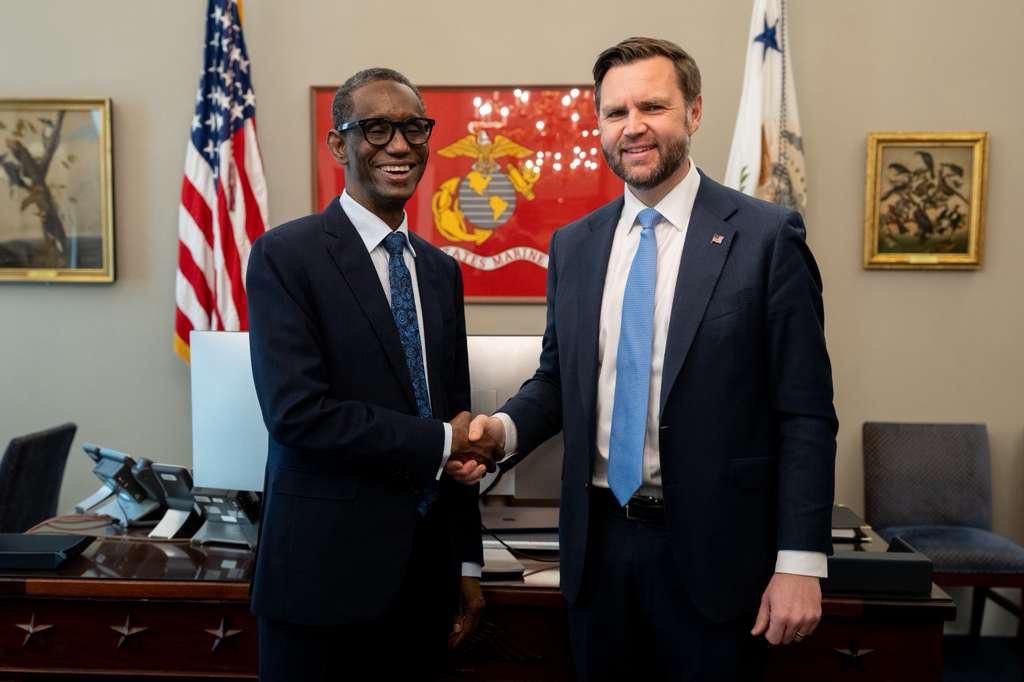
Nigeria and the United States have reaffirmed their commitment to strengthening bilateral cooperation on security, counterterrorism, intelligence sharing, and regional stability following a series of high-level meetings in Washington involving Nigeria’s National Security Adviser, Nuhu Ribadu.
Ribadu undertook a three-day working visit to the United States from May 4 to May 6, during which he met with top U.S. officials, including J. D. Vance and Marco Rubio, as part of efforts to deepen strategic relations between both countries.
According to a State House press release issued on Friday by presidential spokesman Bayo Onanuga, the meetings focused on enhancing collaboration in counterterrorism operations, defence cooperation, regional security, democratic governance, and economic resilience.
Ribadu conveyed the commitment of President Bola Ahmed Tinubu to sustaining Nigeria’s longstanding strategic partnership with the United States, while stressing the need for stronger international cooperation in addressing emerging security threats across West Africa and the Sahel.
The NSA highlighted terrorism, violent extremism, transnational organised crime, and cyber threats as major concerns confronting the region. He reiterated Nigeria’s role as a frontline state in counterterrorism efforts within the Lake Chad Basin and across West Africa.
The engagements also involved discussions with U.S. Under Secretary for Political Affairs Allison Hooker and Assistant Secretary of War Daniel Zimmerim, where both sides reviewed the current state of Nigeria–U.S. relations and assessed progress under the Nigeria–U.S. Joint Working Group framework.
- My Ex-Husband Demanded Regular Payments Before Intimacy, Leaks Private Video – Alhaja Kaola
 Nigerian broadcaster Alhaja Kaola has alleged that her former husband…
- CAF Reverses Four-Year Plan, Confirms AFCON Will Hold Every Two Years
 The Confederation of African Football (CAF) has reversed its earlier…
Read More “CAF Reverses Four-Year Plan, Confirms AFCON Will Hold Every Two Years” »
During the talks, Ribadu expressed appreciation to the U.S. government for its continued support in areas including security assistance, intelligence cooperation, defence capacity building, humanitarian interventions, and counterterrorism operations.
Both countries discussed practical measures aimed at improving intelligence sharing, military cooperation, border security, strategic communications, and institutional capacity development for Nigerian security agencies.
Ribadu also briefed U.S. officials on ongoing reforms and operational measures by the Nigerian government to tackle insecurity and stabilise affected communities. He said the Tinubu administration was adopting a whole-of-government approach that combines military operations with non-kinetic strategies such as community engagement, deradicalisation programmes, economic development, and regional partnerships.
U.S. officials reportedly commended Nigeria’s leadership role in promoting peace and security across Africa and reaffirmed Washington’s recognition of Nigeria as a critical strategic partner on the continent.
The meetings concluded with both countries pledging to sustain diplomatic dialogue, deepen defence and security cooperation, and ensure effective implementation of bilateral initiatives under the Joint Working Group framework.
Nigeria and the United States also expressed optimism about the future of their strategic partnership, reaffirming their commitment to advancing shared interests and addressing common regional and global challenges.