

Russia has escalated its war on Ukraine with the deployment of its nuclear-capable Oreshnik missile during a large-scale overnight assault involving missiles and drones, killing at least four people and injuring 19 in Kyiv, Ukrainian authorities confirmed.
Kyiv Mayor Vitali Klitschko said the dead included a medical doctor, while four other healthcare workers were among the injured. He disclosed that critical infrastructure was damaged in the attack, leaving parts of the capital without electricity and water. Klitschko shared the update via Telegram on Friday morning as emergency services continued rescue and repair operations.
Russia’s Defence Ministry claimed the strikes were retaliation for what it described as a “terrorist attack” allegedly carried out by Ukraine on President Vladimir Putin’s Valdai residence on December 29, 2025. According to Moscow, facilities involved in drone production and energy infrastructure were deliberately targeted.
The Kremlin further alleged that Ukraine attempted to strike Putin’s residence using 91 drones, all of which it said were intercepted and destroyed by Russian air defences. However, independent experts have questioned the credibility of Russia’s account, while Ukraine has flatly denied the accusation, accusing Moscow of fabricating the claim to justify intensified attacks on civilian and government targets.
In western Ukraine, the Air Force’s Western Command earlier reported that the city of Lviv was hit by what was initially described as an unidentified ballistic missile. Ukrainian military officials later confirmed the missile was launched from Russia’s Kapustin Yar test range in Astrakhan—widely known as a launch site for the Oreshnik medium-range ballistic missile.
Lviv Mayor Andriy Sadovyi said explosions were recorded in the city but noted that, as of the latest update, there were no reports of casualties or damage to residential or civilian facilities.
- Nigeria’s First Ebola Patient Identified as Wife of Swiss Diplomat as Authorities Probe Source of Infection
 Nigeria’s latest Ebola case has been traced to a 42-year-old…
- MURIC Seeks Police Probe into Alleged Killing of Man Inside Oyo Mosque
 The Muslim Rights Concern (MURIC) has petitioned the police over…
Read More “MURIC Seeks Police Probe into Alleged Killing of Man Inside Oyo Mosque” »
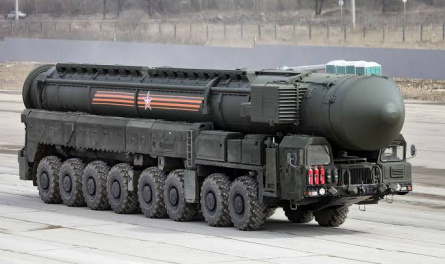
Russia’s Defence Ministry subsequently confirmed the use of the Oreshnik missile system in the strikes, marking only the second time the weapon has been deployed against Ukraine. In a statement quoted by state news agency TASS, the ministry said Russian forces carried out a “massive strike” using high-precision, long-range ground- and sea-based weapons, including the Oreshnik missile complex and attack drones.
The Oreshnik missile was first used against Ukraine in November 2024, when it struck the industrial city of Dnipro. At the time, President Putin said the attack was retaliation for Ukraine’s use of Western-supplied long-range weapons against targets inside Russia.
Putin has repeatedly claimed that Western air defence systems are incapable of intercepting the Oreshnik missile, whose name translates to “hazel shrub” in Russian. He has also asserted that the weapon has the range to strike targets deep into Western Europe.
Although the first Oreshnik missile fired at Ukraine reportedly carried no warheads, relying solely on extreme speed to cause damage, the system is capable of delivering both conventional and nuclear payloads. With speeds estimated at up to 12,000 kilometres per hour and a range of roughly 5,000 kilometres, defence analysts say the missile represents a significant potential threat beyond Ukraine.
The Russian military said the latest Oreshnik missile used in the attack carried conventional warheads.