


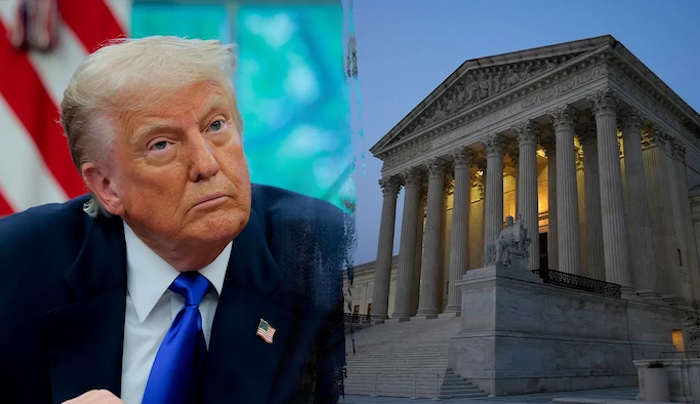
U.S. President Donald Trump has announced a sweeping increase in tariffs on imported goods, raising the baseline global rate to 15 percent in a move that comes on the heels of a restrictive ruling by the Supreme Court of the United States. The development marks a dramatic escalation in trade policy and sets the stage for renewed economic and legal tensions both domestically and internationally.
The controversy began after the Supreme Court ruled that Trump had exceeded his authority under the International Emergency Economic Powers Act (IEEPA) in imposing broad import duties. The court emphasized that while the president holds certain emergency economic powers, the Constitution vests the authority to impose taxes and tariffs primarily in Congress. The decision was widely interpreted as a significant check on executive power in trade matters.
Within hours of the ruling, the White House unveiled a revised strategy. Trump first introduced a 10 percent across-the-board tariff on foreign goods, signaling his administration’s determination to maintain pressure on trading partners. By the following day, he escalated the measure further, announcing that the tariff rate would be raised to 15 percent with immediate effect.
In defending the move, Trump argued that alternative statutory authority exists to justify the action. He cited provisions under the Trade Act of 1974, particularly Section 122, which allows the president to impose temporary import surcharges of up to 15 percent in cases involving balance-of-payments concerns. Unlike the emergency powers previously invoked, this mechanism is limited in duration and requires congressional oversight if extended beyond 150 days.
The president made his position clear in a post on Truth Social, where he criticized the court’s reasoning and insisted that protecting American industries from what he described as unfair foreign competition remains a top priority. He maintained that the tariff hike is lawful under the alternative trade statute and necessary to defend domestic manufacturing and employment.
The sudden policy shift has rattled global markets. Investors reacted with caution amid fears of renewed trade disruptions. Analysts noted increased volatility across equities, particularly in sectors heavily reliant on international supply chains. Commodity markets also reflected uncertainty as traders assessed the potential ripple effects of higher import costs on global demand.
- Bournemouth Humiliate Manchester United 3-0 at Old Trafford as Carrick Faces Mounting Pressure
 Bournemouth delivered another painful blow to Manchester United on Sunday,…
- Tragedy in Kogi: Police Corporal Allegedly Kills Female Colleague, Takes Own Life After Reported Relationship Crisis
 A tragic shooting incident involving two serving police officers has…
Major trading partners, including the European Union, the United Kingdom, Japan and India, are now reviewing the implications of the new tariff regime. Officials in several capitals have indicated they may pursue diplomatic consultations or consider responsive trade measures if negotiations with Washington fail to ease tensions.
Trade experts say the administration’s reliance on Section 122 of the Trade Act is unusual, as it has rarely been used for sweeping global tariffs. The temporary nature of the authority also introduces a layer of uncertainty, as any extension beyond the initial time frame would require action by United States Congress. This creates a potential flashpoint in an already polarized political environment.
Supporters of the president argue that decisive tariff measures are essential to reduce trade imbalances and strengthen domestic production. Critics, however, warn that higher import duties could translate into increased consumer prices and strained diplomatic relations with allies, potentially triggering retaliatory actions that disrupt global supply chains.
As the legal and political debate unfolds, attention now turns to how Congress will respond and whether further court challenges may arise. The 15 percent global tariff stands as one of the most assertive trade maneuvers of Trump’s presidency, underscoring his administration’s willingness to test the limits of executive authority in pursuit of its economic agenda.