

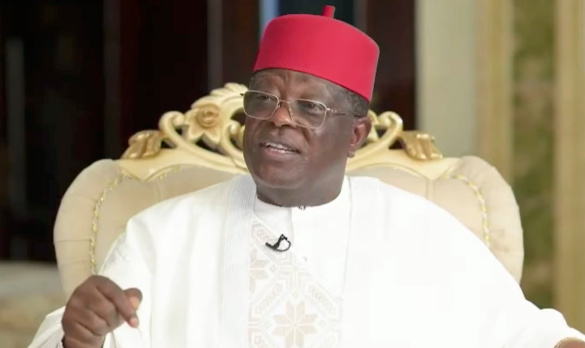
Minister of Works David Umahi has questioned Peter Obi’s approach to his presidential ambition, arguing that the former Anambra State governor should have consulted political leaders across the Southeast before pursuing the nation’s highest office. Umahi maintained that the region has other qualified individuals who should also be considered for the presidency.
The minister made the remarks during an interview with ARISE News, where he challenged the notion that Obi should automatically emerge as the preferred presidential candidate from the Southeast. His position centres on the need for broader consultations and political consensus among leaders from the region before any individual claims a leading role in its quest for national power.
Umahi’s comments have reopened discussions about political representation in the Southeast, particularly over whether the region should rally behind one prominent contender or explore the credentials and ambitions of other political figures. He argued that the region’s political future should not be defined exclusively by one individual’s presidential aspirations.
The former Ebonyi State governor also stressed the importance of engaging influential stakeholders before embarking on a presidential campaign. According to his argument, consultations could help secure wider support, strengthen political alliances and establish a common position among regional leaders on how best to pursue the presidency.
Umahi’s position further highlights the distinction between individual political ambition and collective regional interest. While Obi has attracted considerable national attention since his participation in the 2023 presidential election, the minister maintained that his prominence should not prevent other qualified Southeast politicians from seeking the same office.
The minister also drew attention to the geographical diversity of the Southeast, arguing that conversations about producing a Nigerian president from the region should extend beyond Anambra State. The five states in the geopolitical zone are Abia, Anambra, Ebonyi, Enugu and Imo, each with political leaders and interests that could feature in discussions about the region’s future presidential ambitions.
Obi’s political engagements ahead of the 2027 general election have included discussions with political leaders outside his home state, reflecting the importance of coalition-building in Nigeria’s presidential contests. However, Umahi’s criticism suggests that, in his view, consultations with leaders across the Southeast should also form an important part of the process.
The minister’s remarks must also be viewed against the backdrop of his position in President Bola Tinubu’s administration. Umahi has defended political cooperation between the ruling All Progressives Congress and leaders from the Southeast, arguing that the region’s interests can be advanced through alliances that extend beyond its geographical boundaries.
The debate comes as political actors begin positioning themselves ahead of the 2027 elections, with questions about party platforms, regional representation and national coalitions expected to remain prominent. Any presidential aspirant will need to navigate these competing interests while building support across Nigeria’s diverse political landscape.
Umahi’s intervention has therefore added to the debate over who should represent the Southeast in the contest for Nigeria’s presidency. While he insists that the region has other qualified contenders and that wider consultations are necessary, the eventual direction of its political alignment will depend on negotiations among political leaders, party decisions and the choices Nigerians make at the polls.
- AFCOM-HS: New Military Medical College Listed on JAMB Portal for 2026/2027 Admission
 The Armed Forces College of Medicine and Health Sciences (AFCOM-HS),…
Read More “AFCOM-HS: New Military Medical College Listed on JAMB Portal for 2026/2027 Admission” »
- Arsenal Sink Everton as Aston Villa Shock Man City in Dramatic Premier League Saturday
 Arsenal strengthened their challenge for the English Premier League title…
Read More “Arsenal Sink Everton as Aston Villa Shock Man City in Dramatic Premier League Saturday” »