



The World Health Organisation (WHO) has warned that the Ebola outbreak in the Democratic Republic of Congo (DRC) remains “far from being under control”, as the disease continues to spread at an unprecedented pace and threatens to cross into more countries.
WHO Director-General Tedros Adhanom Ghebreyesus issued the warning amid growing concern over the speed of transmission and the difficulty health authorities are facing in keeping pace with new infections. He said the outbreak had gained a significant head start, leaving responders struggling to catch up.
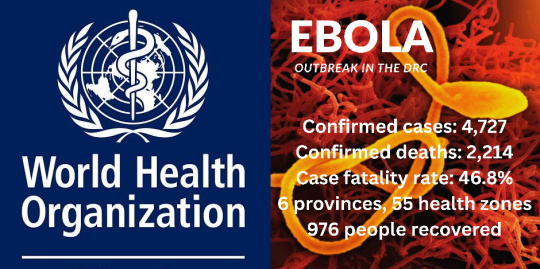
The outbreak, caused by the Bundibugyo species of Ebola virus, has now become the largest Ebola outbreak ever recorded in the DRC by number of cases. Government figures reported on August 19 showed that confirmed infections had risen to 5,021, while deaths had reached 2,378.
The scale of the outbreak has also pushed the DRC past its previous record Ebola epidemic of 2018–2020, which recorded 3,317 cases. The current epidemic is now regarded as the second-largest Ebola outbreak globally, behind the devastating 2014–2016 West African epidemic.
Health officials are particularly concerned about the speed of transmission. The Associated Press reported that the current outbreak has spread roughly three times faster than the West African epidemic from 2014 to 2016, underscoring the enormous pressure on health authorities and response teams.
The outbreak has also expanded geographically. According to the WHO’s latest detailed situation report, cases had been detected across 54 health zones in six provinces as of August 12: Ituri, North Kivu, South Kivu, Haut-Uélé, Tshopo and Bas-Uélé. Ituri remained the epicentre, accounting for about 85 per cent of confirmed cases recorded at that point.
The situation is being worsened by insecurity, population displacement and extensive movement of people, including cross-border travel and commercial activities. WHO has warned that these factors make surveillance, contact tracing and early isolation considerably more difficult and increase the possibility of further regional transmission.
Another major challenge is the absence of an approved vaccine or specific treatment for Bundibugyo virus disease. The WHO says the response therefore depends heavily on early detection, laboratory testing, isolation and supportive care, contact tracing, infection prevention measures, safe burials and cooperation from affected communities.
The international health body has nevertheless intensified efforts to contain the outbreak. WHO and its partners are expanding treatment capacity, strengthening surveillance and deploying additional health personnel, while clinical research is underway to assess potential treatments and vaccine options for the Bundibugyo strain.
The DRC outbreak was declared a Public Health Emergency of International Concern (PHEIC) on May 17, 2026, reflecting concerns about its potential to spread beyond national borders. WHO currently assesses the risk as very high within the DRC and high for neighbouring countries with relevant cross-border exposure, although the global risk remains assessed as low.
Despite the alarming figures, WHO maintains that the outbreak can still be contained if the response is rapidly strengthened and sufficient resources are mobilised. The immediate challenge, however, remains closing the gap between the speed at which the virus is spreading and the ability of health authorities to detect, isolate and treat cases before transmission continues.
- Nigeria’s First Ebola Patient Identified as Wife of Swiss Diplomat as Authorities Probe Source of Infection
 Nigeria’s latest Ebola case has been traced to a 42-year-old…
- MURIC Seeks Police Probe into Alleged Killing of Man Inside Oyo Mosque
 The Muslim Rights Concern (MURIC) has petitioned the police over…
Read More “MURIC Seeks Police Probe into Alleged Killing of Man Inside Oyo Mosque” »