




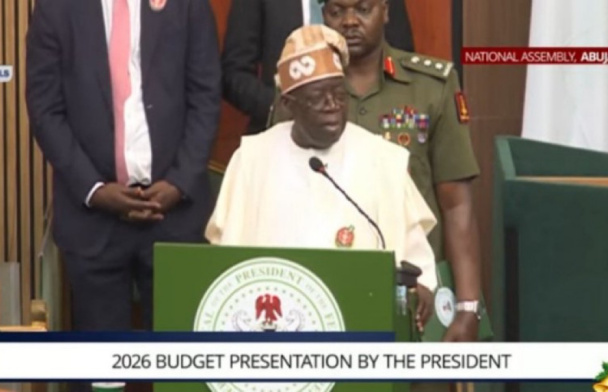
President Bola Ahmed Tinubu has presented a ₦58.47 trillion federal budget proposal for the 2026 fiscal year to the National Assembly, outlining the Federal Government’s spending priorities amid ongoing economic reforms and security challenges. The proposal was laid before a joint session of the Senate and the House of Representatives in Abuja, reinforcing the administration’s focus on security, economic consolidation and social development.
The 2026 Appropriation Bill, themed “Budget of Consolidation, Renewed Resilience and Shared Prosperity,” reflects the government’s intention to stabilise recent reforms while expanding investments in critical sectors. President Tinubu said the budget was designed to protect economic gains, strengthen institutions and improve the welfare of Nigerians despite global economic uncertainties.
A major highlight of the budget is the allocation of ₦5.41 trillion to defence and security, making it the single largest sectoral vote. The allocation underscores the administration’s commitment to tackling terrorism, banditry, kidnapping and other security threats that have affected economic activity and social stability across the country.
According to the President, the defence allocation will be used to modernise the Armed Forces, strengthen intelligence gathering, improve border security and enhance joint operations among security agencies. He noted that national security remains the foundation for sustainable economic growth and investor confidence.
- Nigeria’s First Ebola Patient Identified as Wife of Swiss Diplomat as Authorities Probe Source of Infection
 Nigeria’s latest Ebola case has been traced to a 42-year-old…
- MURIC Seeks Police Probe into Alleged Killing of Man Inside Oyo Mosque
 The Muslim Rights Concern (MURIC) has petitioned the police over…
Read More “MURIC Seeks Police Probe into Alleged Killing of Man Inside Oyo Mosque” »
Beyond security, the 2026 budget places strong emphasis on infrastructure development, with ₦3.56 trillion earmarked for roads, rail, power and other capital projects. The government said these investments are critical for improving productivity, reducing the cost of doing business and stimulating inclusive economic growth.
Education also received significant attention, with an allocation of ₦3.52 trillion aimed at improving access, quality and infrastructure across all levels of learning. The health and social services sector was allocated ₦2.48 trillion to strengthen healthcare delivery, expand social safety nets and improve overall human capital outcomes.
On the expenditure side, recurrent non-debt spending is estimated at about ₦15.25 trillion, covering salaries, overheads and the day-to-day running of government. Capital expenditure forms a substantial part of the budget, reflecting the administration’s intention to balance governance costs with long-term development investments.
The budget is anchored on key macroeconomic assumptions, including a crude oil benchmark price of about US$64.85 per barrel, oil production of 1.84 million barrels per day and an exchange rate projection of ₦1,400 to the US dollar. These assumptions were described as conservative and realistic given global oil market volatility and domestic revenue challenges.
President Tinubu urged lawmakers to give the budget prompt consideration, stressing the need for timely passage to ensure effective implementation from the start of the fiscal year. He also called for collaboration between the executive and legislative arms to deliver a budget that responds to the needs of citizens.
With defence, infrastructure and human capital development topping the spending chart, the proposed 2026 budget continues a pattern of prioritising security and economic stability. As the National Assembly begins its review, attention will focus on revenue projections, deficit financing and how effectively the ambitious ₦58.47 trillion plan can translate into improved security, growth and shared prosperity for Nigerians.