


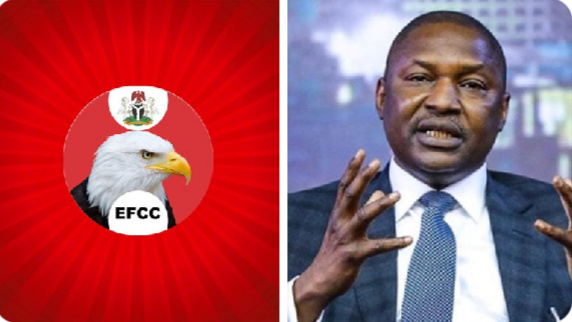
The Economic and Financial Crimes Commission (EFCC) has intensified its investigation into 46 bank accounts allegedly linked to former Attorney-General of the Federation and Minister of Justice, Abubakar Malami, marking one of the most extensive financial scrutiny operations involving a former top government official. The probe, which gained momentum this week, is part of a broader review of transactions executed during Malami’s tenure under the previous administration.
According to reliable sources, Malami appeared before EFCC investigators on Monday for interrogation but was detained overnight after arriving late for the scheduled session. His questioning reportedly extended deep into the night as investigators sought detailed explanations on the origin, purpose, and financial activities associated with the accounts. He has since been mandated to report daily to the commission as the investigation continues.
By God’s grace🙏, the event was a success. We’re now at 50% of our target and hope to complete🫠funds before Dec 24, 2025.
If you’d like to give, please use:
ToyinOlomo Int’l Foundation – FCMB 7616705014
This is a broadcast message,✍️
The inquiry into the 46 bank accounts forms only a segment of a much wider investigation. The EFCC is said to be reviewing several high-value transactions linked to Malami’s office, including controversial settlements, judgment debts, and recovered asset repatriations. Among these is the disputed US$496 million payment to Global Steel Holdings Ltd concerning the Ajaokuta Steel Company concession, a payment that has drawn public scrutiny due to earlier waivers granted by the company.
Also under review is the US$419 million Paris Club refund judgment debt, which was paid to consultants under questionable circumstances. Investigators are re-examining documents to determine whether due process was followed in authorizing the controversial payments. The commission is further probing the US$200 million settlement involving Sunrise Power over the protracted Mambilla power project dispute.
- Nigeria’s First Ebola Patient Identified as Wife of Swiss Diplomat as Authorities Probe Source of Infection
 Nigeria’s latest Ebola case has been traced to a 42-year-old…
- MURIC Seeks Police Probe into Alleged Killing of Man Inside Oyo Mosque
 The Muslim Rights Concern (MURIC) has petitioned the police over…
Read More “MURIC Seeks Police Probe into Alleged Killing of Man Inside Oyo Mosque” »
In addition, the EFCC is reportedly assessing allegations surrounding the disposal of assets forfeited by politically exposed individuals. These assets, sold or reassigned during Malami’s tenure, have raised questions about valuation, transparency, and compliance with due process rules. Another key concern is the alleged duplication of legal fees connected to the repatriation of recovered funds, including portions of the Abacha loot returned to Nigeria between 2018 and 2020.
To aid the investigation, the EFCC has seized Malami’s international passport and placed him on a travel watchlist. Officials noted that the scale of the probe requires consistent access to Malami and a wide range of supporting documents. The restriction, they emphasized, is a routine measure in high-profile corruption inquiries to prevent interference with ongoing investigations.
Malami, however, has publicly dismissed the allegations as unfounded, fabricated, and politically motivated. He maintains that all actions taken during his time as Attorney-General were lawful, transparent, and in the interest of the Nigerian state. He specifically defended his role in the management of recovered assets, describing the allegations of misappropriation as “illogical”.
Despite Malami’s rebuttal, EFCC sources indicate that the probe is expected to continue throughout December due to the volume of transactions under review. Investigators are focusing on tracing fund flows, identifying beneficiaries, and determining whether any of the accounts were used for illicit enrichment, unauthorized payments, or covert financial operations.
At the moment, no formal charges have been filed against the former minister. The EFCC has stated that conclusions will only be made after a comprehensive and painstaking examination of all evidence. The agency has also promised to make its findings public once the investigative phase is concluded.
This developing case marks a significant moment in Nigeria’s anti-corruption campaign, given Malami’s former position as the country’s chief law officer. The outcome of the probe could influence public confidence in ongoing reforms around asset recovery, public finance management, and accountability for high-ranking government officials.