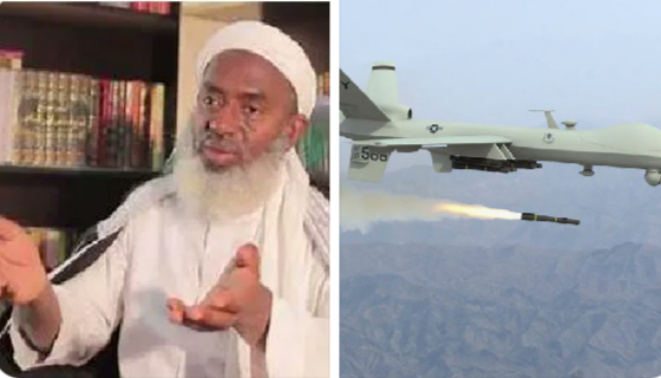
Islamic cleric Sheikh Ahmad Abubakar Gumi has urged the Federal Government of Nigeria to immediately suspend military cooperation with the United States, following recent U.S.-led airstrikes targeting Islamic State (ISIS) fighters in parts of north-west Nigeria.
Gumi made the call after confirmation that American forces, working with Nigerian authorities, carried out precision airstrikes against ISIS-affiliated terrorist camps, a development that has sparked nationwide debate over sovereignty, security strategy, and foreign military involvement.
Speaking via a public statement shared on social media, the cleric warned that continued cooperation with the U.S. military could expose Nigeria to greater insecurity rather than reduce it. He argued that foreign military intervention often turns countries into battlegrounds for global power struggles.
According to Gumi, Nigeria risks becoming a proxy war zone if it allows Western powers to directly conduct combat operations on its soil. He maintained that terrorism in Nigeria should be tackled primarily by Nigerian security forces, with intelligence support rather than active combat involvement from foreign nations.
- Bournemouth Humiliate Manchester United 3-0 at Old Trafford as Carrick Faces Mounting Pressure
 Bournemouth delivered another painful blow to Manchester United on Sunday,…
- Tragedy in Kogi: Police Corporal Allegedly Kills Female Colleague, Takes Own Life After Reported Relationship Crisis
 A tragic shooting incident involving two serving police officers has…
The cleric also expressed concern over the narrative surrounding the strikes, particularly suggestions that the operation was partly aimed at protecting Christian communities. He cautioned that framing counter-terrorism efforts along religious lines could worsen sectarian tensions in a country already struggling with ethno-religious divisions.
Gumi further questioned the choice of operational areas for the airstrikes, noting that the north-east remains the epicentre of insurgency in Nigeria. He argued that focusing military action elsewhere could fuel suspicion and mistrust among local populations.
In place of U.S. military partnership, Gumi suggested Nigeria explore cooperation with what he described as “neutral countries”, including China, Turkey, or Pakistan, which he believes may offer technical support without geopolitical dominance.
Meanwhile, both the United States and Nigerian authorities have confirmed that the airstrikes were conducted following intelligence indicating the presence of ISIS-linked fighters responsible for deadly attacks on civilians. U.S. officials described the operation as part of a broader international effort to degrade terrorist networks in West Africa.
The Nigerian government has defended its security partnership with the United States, stressing that all operations were carried out with Nigeria’s consent and within the framework of international law and national sovereignty. Officials insist the collaboration is necessary to combat increasingly sophisticated terrorist groups.
Gumi’s remarks have triggered mixed reactions across the country, with some Nigerians supporting his sovereignty concerns, while others argue that international military assistance remains critical given the scale of Nigeria’s security challenges.
As debates continue, analysts say the controversy highlights the broader question of how Nigeria can balance foreign security cooperation with national independence while effectively addressing terrorism.