

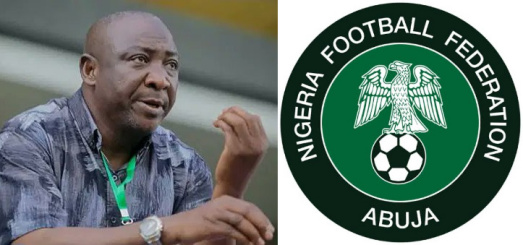
Nigeria’s football administration has been thrown into fresh turmoil following reports that Nigeria Football Federation (NFF) President, Ibrahim Musa Gusau, and several members of the federation’s Executive Committee have resigned from their positions.
The reported resignations came amid mounting pressure on the NFF leadership over a string of setbacks affecting Nigerian football. Multiple Nigerian media outlets reported the development on Thursday, August 27, 2026, although some reports indicated that formal confirmation from the federation was still being awaited.
The pressure on the Gusau-led administration intensified following Nigeria’s failure to qualify for the 2027 FIFA Women’s World Cup, a historic setback for the Super Falcons. Nigeria had participated in every edition of the women’s World Cup since the competition began in 1991.
The Super Falcons’ World Cup setback followed their disappointing campaign at the 2026 Women’s Africa Cup of Nations. The defending champions were eliminated by Cameroon after a 1-0 quarter-final defeat, forcing Nigeria into the qualification playoff route for the global tournament.
Nigeria subsequently suffered another blow when South Africa defeated the Falcons 2-1 in the World Cup qualification playoff. The result left Nigeria facing the unprecedented possibility of missing the women’s World Cup, further intensifying criticism of the country’s football administration.
The NFF leadership has also faced criticism over the Super Eagles’ failure to qualify for consecutive FIFA World Cup tournaments. Nigeria missed the 2026 World Cup after also failing to make the 2022 edition, adding to concerns about the direction of the country’s senior national team.
Beyond results on the pitch, the federation has reportedly faced scrutiny over the handling of government funds released for Nigeria’s national teams. Reports said security agencies were examining the utilisation of a N17 billion intervention fund approved in 2024 to address outstanding payments involving players’ wages and bonuses.
A source cited in reports said the Department of State Services (DSS) had requested documentation relating to the funds. The source, however, reportedly described the examination as a normal process for reviewing government-funded activities rather than necessarily evidence of a witch-hunt against NFF officials.
The leadership crisis had already been building before the latest reported resignation of Gusau. Reports indicated that eight of the 13 members of the NFF board had allegedly resigned, leaving the federation facing serious questions about the stability of its governing structure.
The development could also have consequences for the NFF’s planned elective congress scheduled for September 27 in Lafia, Nasarawa State. With the federation’s leadership structure now under significant pressure, questions are emerging over how the election timetable and other administrative processes will proceed.
As Nigerian football awaits a clearer official position from the federation, the reported departure of Gusau and other board members marks a potentially decisive moment for the sport’s administration. The immediate challenge will be to establish a credible transition and restore confidence in the management of Nigeria’s national teams, competitions and football development programmes.
- Tinubu Flags Off $100m Southeast Gas Pipeline Project to Boost Industrial Growth
 President Bola Tinubu has flagged off a $100 million gas…
Read More “Tinubu Flags Off $100m Southeast Gas Pipeline Project to Boost Industrial Growth” »
- NCC Raises Alarm Over AI-Powered Cyberattacks, Warns of Threats to Telecoms, Banks and National Security
 The Nigerian Communications Commission (NCC) has warned that the growing…