



The African Democratic Congress (ADC) has been thrown into further uncertainty over its 2027 presidential ticket following the circulation of a document which identifies Professor Chris Uba as the party’s presidential candidate and Dr Shamsuddin Modibbo Barkindo as his running mate.
The document, titled Submission of Names of Candidates by Political Parties, carries details of the two individuals under the party’s presidential nomination. It identifies Uba, aged 71, as a male candidate from Anambra State, with educational qualifications from the University of Nigeria, Nsukka, and institutions in the United Kingdom.
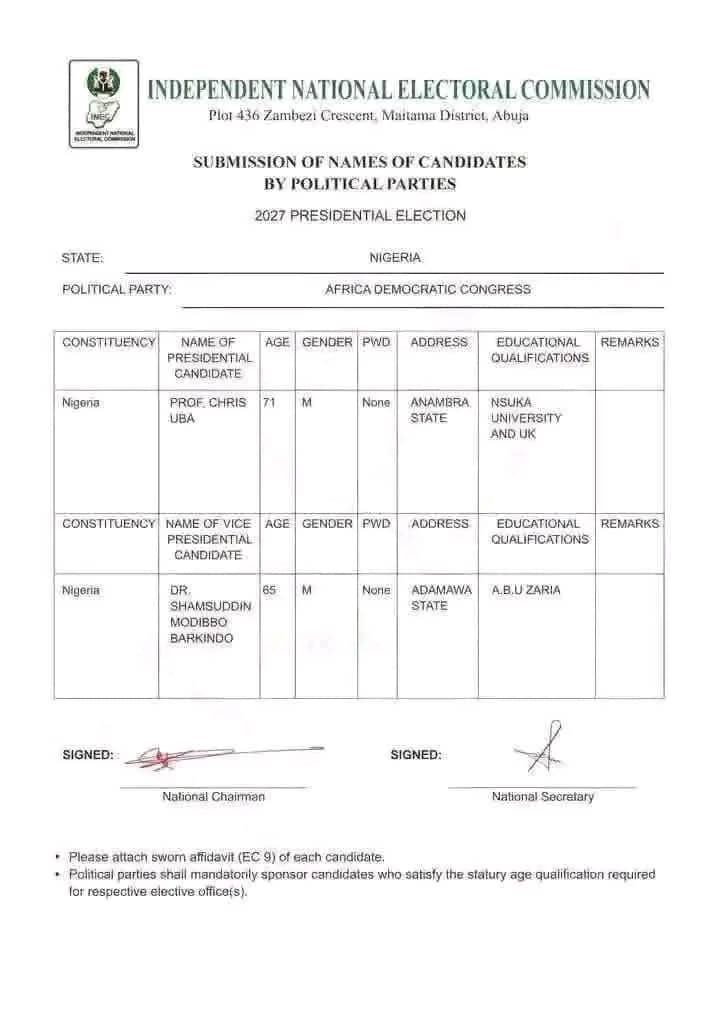
Barkindo, aged 65, is listed as the vice-presidential candidate. The document identifies him as being from Adamawa State and indicates that he attended Ahmadu Bello University, Zaria. Both candidates are recorded as having no physical disability, while the form bears signatures in the spaces designated for the party’s national chairman and national secretary.
However, the appearance of the document does not, in itself, establish that INEC has accepted or recognised the nominations. The distinction is particularly important given the prolonged leadership crisis within the ADC and the existence of competing factions claiming authority over the party’s affairs.
Uba’s emergence is linked to the faction led by Nafiu Bala Gombe, which had earlier announced him as its presidential candidate following what it described as a consensus arrangement. The faction maintained that the nomination followed the withdrawal of two other aspirants, leaving Uba as its preferred candidate for the 2027 presidential election.
The development has also brought renewed attention to the political fortunes of former Vice-President Atiku Abubakar and former Rivers State Governor Rotimi Amaechi, who emerged as the presidential and vice-presidential candidates, respectively, under the ADC leadership led by former Senate President David Mark.
In a statement published on its official website on July 2, the David Mark-led ADC announced that it had successfully uploaded Atiku’s and Amaechi’s particulars to INEC’s nomination portal. The party maintained that the submission was part of its preparations for the 2027 general election. African Democratic Congress
However, the political equation changed significantly on November 5 when a Federal High Court in Abuja nullified the processes that produced the David Mark-led party executive and set aside Atiku’s nomination. The judgment followed a legal challenge instituted by Bala Gombe, who questioned the legitimacy of the party’s leadership structure and argued that the officials had not emerged through a national convention.
The ADC rejected the court’s decision, describing it as politically motivated and announcing its intention to challenge the ruling at the Court of Appeal. The dispute consequently raised fresh questions about the validity of the party’s existing leadership structure and the nomination processes conducted under it.
Nevertheless, the court judgment does not automatically confer recognition on Uba or establish him as Atiku’s replacement. A fact-check published by FactCheckAfrica on November 10 found no evidence that INEC had officially substituted Uba’s name for Atiku’s on its published list. It also noted that the commission had not recognised the Bala-led faction as the party’s official leadership as of November 7.
With the competing claims, court proceedings and uncertainty surrounding INEC’s position, the ADC faces a critical test of its internal cohesion ahead of the 2027 presidential election. Whether Uba eventually secures the party’s recognised ticket or Atiku and Amaechi retain their political claim will depend on the resolution of the leadership dispute, the outcome of the pending legal proceedings and the electoral commission’s eventual position. The circulation of the nomination document has intensified the controversy, but it should not be mistaken for final confirmation of Uba’s candidacy.
- ADC Leadership Crisis: Chris Uba’s Presidential Ticket Emerges Amid Atiku-Amaechi Uncertainty
 The African Democratic Congress (ADC) has been thrown into further…
- 2027 Elections: INEC Activates BVAS Preparations, Deploys Air Force Jets To Distribute Materials Nationwide
 The Independent National Electoral Commission (INEC) has commenced the configuration…