

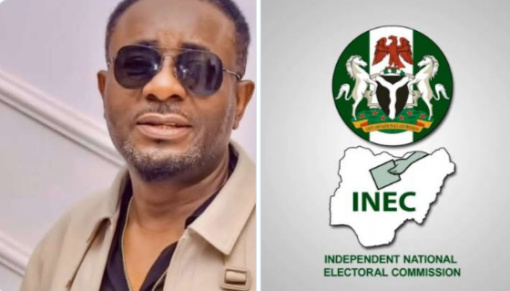
ABUJA, Nigeria — Nollywood actor and politician Emeka Ike has filed a ₦10 billion lawsuit against the Independent National Electoral Commission (INEC) and Lere Olayinka over the alleged unauthorized disclosure of his voter registration information.
The suit, filed at the Federal High Court in Abuja and marked FHC/ABJ/CS/1272/2026, stems from the publication of details from Ike’s voter registration record on social media. According to court documents, the actor argues that the release of the information constituted a violation of his constitutional right to privacy and protections guaranteed under Nigeria’s data protection laws.
The dispute began in late May when Olayinka, spokesperson to the Minister of the Federal Capital Territory (FCT), posted screenshots on X (formerly Twitter) showing details of Ike’s voter registration transfer from Imo State to the FCT. The information appeared to have been obtained from an INEC administrative portal that is ordinarily accessible only to authorized electoral officials.
The publication sparked widespread public concern about the security of voter data and raised questions about how sensitive information held by INEC could have found its way into the public domain.
Through his lawyer, Leonard Adeh, Ike is seeking declarations that the publication of his voter information without his consent amounted to a gross violation of his privacy rights. He also argues that INEC owes a legal duty to safeguard the personal information of registered voters from unauthorized access and disclosure.
The actor is requesting ₦10 billion in damages from both INEC and Olayinka for the alleged breach of his fundamental rights and personal data protections.
INEC has acknowledged the incident and launched an investigation into the release of Ike’s voter information. The electoral body, however, maintains that its database was not hacked and that there was no external breach of its systems. According to the commission, preliminary findings indicate that the information was accessed through valid credentials assigned to authorized personnel involved in the ongoing Continuous Voter Registration (CVR) exercise and was subsequently released without authorization.
The commission further disclosed that its audit trail enabled investigators to identify the user account through which the information was accessed. Relevant personnel have reportedly been questioned as part of the ongoing probe.
The controversy has also attracted the attention of security agencies. Both the Department of State Services (DSS) and law enforcement authorities have reportedly conducted investigations into the circumstances surrounding the disclosure. INEC later stated that an electoral officer allegedly shared the screenshots that eventually reached Olayinka.
Legal observers say the case could become a significant test of Nigeria’s evolving data protection framework and the responsibility of public institutions to safeguard citizens’ personal information. Beyond the individual claims of Emeka Ike, the lawsuit has intensified national discussions about privacy rights, electoral data security, and public trust in government-held databases.
The Federal High Court is expected to determine whether the publication of the actor’s voter registration details constituted a breach of privacy and whether the defendants bear liability for the alleged disclosure.
- AFCOM-HS: New Military Medical College Listed on JAMB Portal for 2026/2027 Admission
 The Armed Forces College of Medicine and Health Sciences (AFCOM-HS),…
Read More “AFCOM-HS: New Military Medical College Listed on JAMB Portal for 2026/2027 Admission” »
- Arsenal Sink Everton as Aston Villa Shock Man City in Dramatic Premier League Saturday
 Arsenal strengthened their challenge for the English Premier League title…
Read More “Arsenal Sink Everton as Aston Villa Shock Man City in Dramatic Premier League Saturday” »