

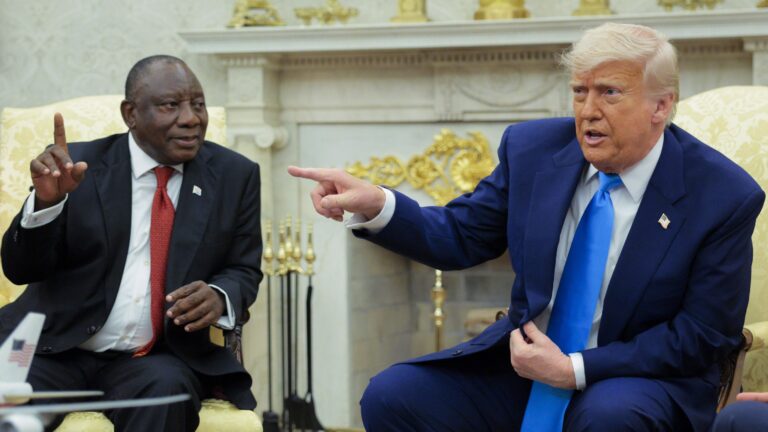
The diplomatic tension between Washington and Pretoria escalated sharply on Wednesday after U.S. President Donald Trump announced that South Africa will not receive an invitation to the 2026 G20 Summit, which the United States is scheduled to host in Miami, Florida. The announcement sent shockwaves through international diplomatic circles, marking one of the most consequential exclusions in the history of the group.
President Trump’s decision stems from a dispute arising from the 2025 G20 Summit held in Johannesburg, where the U.S. was notably absent. Trump said South Africa “refused to follow normal protocol” during the symbolic handover of the G20 presidency, insisting that the South African government declined to pass the ceremonial gavel to a senior representative of the U.S. Embassy. He described the action as a “breach of diplomatic norms” and an unacceptable slight to the incoming host nation.

In addition to the G20 ban, Trump announced that the United States would immediately suspend all forms of financial assistance and subsidies to South Africa. He justified the suspension by asserting that U.S. taxpayers should not fund a government he accuses of “horrific human rights abuses,” repeating claims about alleged persecution of white farmers and minority Afrikaner groups.
South Africa quickly condemned the announcement, calling it “deeply punitive, misleading, and diplomatically unjustifiable.” Officials said the handover in Johannesburg followed established procedures and insisted that the U.S. boycott of the summit created irregular conditions that complicated the formal transition. Pretoria further dismissed claims of widespread human rights violations as “falsehoods driven by political narrative rather than evidence.”
- Nigeria’s First Ebola Patient Identified as Wife of Swiss Diplomat as Authorities Probe Source of Infection
 Nigeria’s latest Ebola case has been traced to a 42-year-old…
- MURIC Seeks Police Probe into Alleged Killing of Man Inside Oyo Mosque
 The Muslim Rights Concern (MURIC) has petitioned the police over…
Read More “MURIC Seeks Police Probe into Alleged Killing of Man Inside Oyo Mosque” »
Observers note that the controversy largely arose because no American official attended the Johannesburg summit, a result of Trump’s directive to boycott the event. With no senior U.S. representative present, South African diplomats argued that handing over the presidency to a lower-ranking embassy official would have been inappropriate, adding that communication with Washington could have resolved the matter beforehand.
Global analysts warn that Trump’s move introduces a dangerous precedent in the functioning of multilateral platforms. The G20, representing the world’s largest economies has historically operated on consensus and inclusion, regardless of political disagreements among member states. Excluding a country that just chaired the summit risks destabilizing the bloc’s tradition of continuity and cooperation.
Critics argue that the exclusion could fracture global economic collaboration at a critical time when nations require collective engagement on security, trade policy, inflation, and climate-related challenges. Several commentators have also described Trump’s approach as “unilateral” and potentially damaging to U.S. diplomatic influence across Africa.
For its part, South Africa vowed to engage other G20 members and international partners to counter what it describes as an attempt to marginalize Africa’s role in global economic discourse. Government officials stressed that South Africa’s presence in the group is essential for representing the interests of emerging economies and the Global South.
Despite pushback from Pretoria and a wave of international reactions, President Trump maintained that the exclusion stands, stating that only “countries that respect the United States and uphold global standards” would be welcome at the Miami summit. The announcement has already drawn mixed reactions within the U.S., with some lawmakers applauding the firm stance and others warning that the decision could erode long-standing diplomatic ties.
As the world looks ahead to the 2026 summit in Miami, uncertainty looms over whether diplomatic negotiations can alter the trajectory of Trump’s decision. For now, the U.S.–South Africa relationship remains strained, and the global community is watching closely to see how this unprecedented development shapes the future of international cooperation.